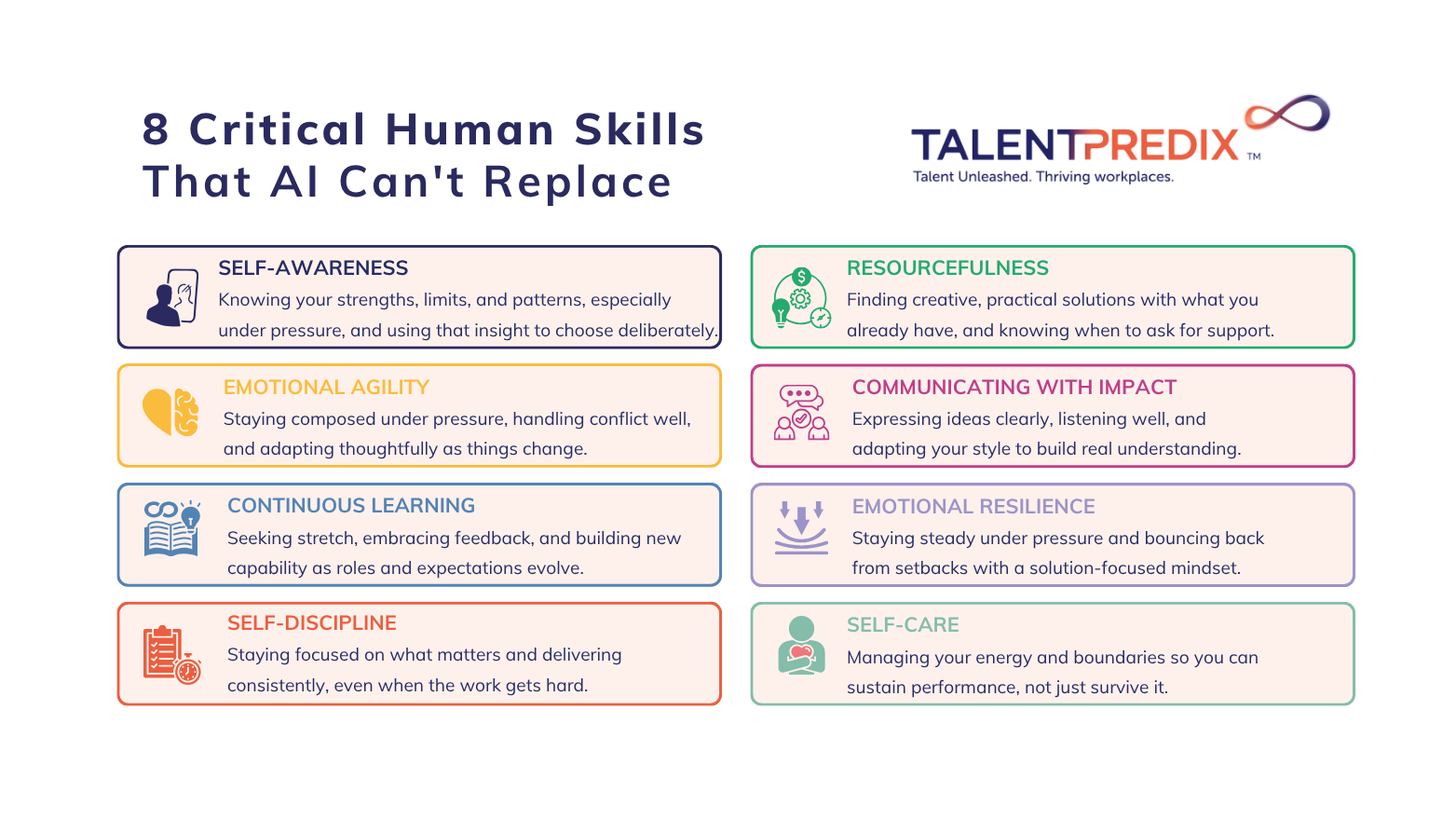
Resourcefulness at work is becoming one of the most important human skills in the Age of AI.
Resilience gets all the headlines. It’s the word HR and leaders reach for when they talk about navigating uncertainty, change, and pressure.
However, there’s a quieter capability working alongside it – one that rarely gets the spotlight, despite being just as important: resourcefulness.
At TalentPredix™, we define resourcefulness as one of the eight Self-Mastery skills – the critical human skills that allow people to perform, adapt, and thrive in the Age of AI. Specifically, it’s about identifying creative, practical solutions using the knowledge, tools, and networks already available to you. It’s adapting quickly to new situations, asking insightful questions, and leveraging support to overcome obstacles effectively.
In other words, resourcefulness is what turns “we don’t have what we need” into “here’s what we can do with what we’ve got.”
Resilience helps us absorb shocks and bounce back. Resourcefulness helps us find a way through in the first place.
The two are deeply connected – research on organizational resilience increasingly frames resourcefulness as a core behavioural dimension of resilience itself, alongside agility in unexpected situations and the ability to adapt routines and reallocate resources when conditions shift. Research from Gallup also highlights the importance of helping people use their strengths effectively to improve performance and adaptability.
This matters because uncertainty rarely arrives as a single dramatic event. More often, it shows up as a steady stream of smaller ambiguities – shifting priorities, incomplete information, new tools, unclear instructions. Resourcefulness is the skill that keeps people moving productively through all of that noise, rather than waiting for clarity that may never fully arrive.
There’s also a strong theoretical basis for why resourcefulness fuels motivation under pressure. Conservation of Resources theory, one of the most influential frameworks in organizational psychology, holds that people are fundamentally motivated to protect and build up the resources – strengths, skills, knowledge, relationships, tools – that help them cope with stress and pursue goals. Resourcefulness is essentially this theory in action: it’s the active, deliberate process of mobilising, combining and strengthening resources, rather than passively waiting for the right conditions to appear. When people feel capable of generating options for themselves, motivation tends to follow.
As AI takes over more routine, information-processing tasks, the value of resourcefulness only grows.
AI can generate options, summarise information, and surface possibilities at speed – but someone still has to decide which option fits the situation, ask the right follow-up question, or combine an AI output with a piece of tacit knowledge that only a human would think to apply.
That’s resourcefulness at work: using all available tools and resources, including AI itself, creatively and practically to solve real problems.
Like all Self-Mastery skills, resourcefulness isn’t fixed.
Developing resourcefulness at work requires more than resilience training alone.
It can be developed through deliberate practice: rotating people through unfamiliar challenges and stretch opportunities, encouraging them to ask “what do we already have that could help here?”, and creating environments where experimentation and creative problem-solving are genuinely encouraged and safe.
Organizations that develop resourcefulness alongside resilience build something powerful – people who don’t just survive uncertainty, but actively find their way through it. Organizations that strengthen resourcefulness at work create people who can adapt, solve problems, and thrive through uncertainty. In a world where change is constant and answers are rarely handed to us, that might be the most powerful human skill of all.
Resourcefulness is one of eight Self-Mastery skills measured in the TalentPredix™ 360, the only assessment that reveals Strengths, Motivations, Values, and Critical Human Skills together.
See how resourcefulness and the other seven Self-Mastery skills show up across your organization. Request a free trial or view a sample profile to see it in action.
This is the first post in our Self-Mastery Series. Each week, we’re breaking down one of the eight skills, what it means, why it matters, and how to build it deliberately. Next up: Emotional Agility.
Every leader I speak to right now is somewhere on the same spectrum: either cautiously optimistic about AI, quietly overwhelmed by it, or both simultaneously. And that tension – that contradictory experience of feeling more capable and more exhausted at the same time – turns out to be exactly what the research is uncovering.
We’ve been told the story of AI as relief. Less admin. Faster decisions. More time for the strategic, human work that matters. It’s a compelling narrative. But a growing body of evidence suggests it’s an incomplete one – and for leaders in particular, the gap between the promise and the reality deserves serious attention.
A landmark study published in Harvard Business Review by Aruna Ranganathan and Xingqi Maggie Ye found something striking: when a 200-person tech company gave employees access to generative AI tools, they didn’t work less. They worked more – at a faster pace, across a broader range of tasks, and deeper into their evenings. Nobody asked them to. They just did, because AI made doing more feel possible.
“You had thought that maybe, because you could be more productive with AI, you save some time, you can work less. But then really, you don’t work less. You just work the same amount or even more.”
— Engineer, quoted in HBR study on AI and work intensification
The study identified three distinct patterns: task expansion (people absorbing work that would previously have gone to others), blurred work-life boundaries (AI made starting a task so frictionless that workers slipped prompts into lunch breaks and late evenings), and constant multitasking (managing multiple AI threads simultaneously, creating cognitive load even as it felt productive). The result was a self-reinforcing cycle: AI accelerated tasks, which raised expectations for speed, which created greater reliance on AI, which widened scope further.
This lands on leaders who were already struggling. Research by Oracle cited in a second HBR study found that 85% of business leaders have experienced decision stress, with three-quarters reporting a tenfold increase in daily decisions over the previous three years. Poor decision-making is estimated to cost firms at least 3% of profits annually – and that’s before we factor in the reputational costs of a single poorly handled crisis.
There’s a deeper paradox at work here. AI gives leaders access to more data, more analysis, and more options than ever before. But more isn’t always better. In practice, the cognitive load of processing vast amounts of information – much of it beyond what you actually need to make a sound decision – is itself a significant source of pressure. Research consistently shows that decision quality degrades as the volume of information increases past a certain threshold.
AI can surface fifty data points where five would suffice, and the effort required to evaluate, filter, and contextualise all of it quietly drains the very capacity leaders need for clear-headed judgment. The result is what researchers call decision fatigue: the more choices and information you process, the poorer your subsequent decisions become. AI, paradoxically, can intensify exactly the problem it promises to solve.
DDI’s Global Leadership Forecast 2025 found that 71% of nearly 11,000 leaders reported rising stress levels since taking on their current role – up from 63% in 2022. Successfully leveraging AI was cited as a top stressor by 29% of respondents. In other words, the very tool meant to relieve pressure is now a source of it.
“AI doesn’t just give you more information – it gives you more than you can act on. And more data without better judgement doesn’t improve decisions; it just makes poor ones feel more justified. The leaders who get the most from AI aren’t the ones who use it most. They’re the ones who know what question they’re trying to answer before they ask it – and who bring the human judgement to know what the answer actually means.”
— James Brook, TalentPredix™
What makes this particularly tricky for leaders is that the overload is largely invisible – to themselves and to their organizations. Because employees are expanding their workloads voluntarily, and framing it as energising experimentation, it rarely registers as a problem until it becomes one. A 2026 ActivTrak analysis confirmed the pattern: after AI adoption, task volume and multitasking rose while focused work fell. Burnout isn’t just driven by hours worked – it’s driven by fragmentation, decision fatigue, and lack of recovery time.
Meanwhile, the DHR Global Workforce Trends Report 2026 found 83% of workers reporting at least some degree of burnout, with burnout’s influence on engagement growing sharply – 52% of workers now say burnout drags down engagement, up from 34% in 2025. At the same time, ManpowerGroup’s Global Talent Barometer 2026 found AI adoption jumped 13% while confidence in using AI fell 18%. The tools are spreading faster than the support structures around them.
The HBR research on decision-making under pressure makes clear that AI genuinely can help – as a sounding board, a co-pilot for synthesising complex risk data, a tool for stress-testing decisions before you commit. The question is whether it’s being deployed intentionally, or just absorbed into the existing pressure. Here’s what the research, and hard-won experience, suggests good leadership looks like in practice.
Not slow-downs, but structured moments to check alignment and absorb information before pressing forward. AI removes friction, which is mostly good, but friction sometimes served a purpose. A quick decision pause before a major commitment – one counterargument, one explicit link to your strategic goals – can prevent the kind of drift that only becomes visible in hindsight.
The blurring of work and non-work is one of the most consistent findings across the research. Because AI makes it so easy to start a task, people stop stopping. Leaders need to model clear boundaries – no prompting during lunch, no ‘quick last query’ at 10pm – and build team norms that make it safe to switch off. Deloitte’s 2025 Workforce Intelligence Report identified cognitive strain and decision friction as the leading indicators of burnout, ahead of workload volume for the first time. Boundaries aren’t soft; they’re structural and vital for effective performance.
There’s a subtle but important shift that happens when AI moves from tool to authority – when its outputs stop being inputs to your thinking and start being the answer. Leaders need to actively resist this. AI works best when it serves the human agenda, not the other way around. That means using it to interrogate your assumptions, not validate them; to widen your options, not close them down. As one expert framed it in the HBR decision-making research: AI functions best as a teammate that challenges your thinking – not an oracle that ends it. The moment your team stops questioning AI outputs is the moment the risk quietly rises.
AI gives you one synthesised perspective. It draws on patterns in data; it doesn’t draw on lived experience, organizational context, or the kind of judgment that comes from genuinely knowing your people. The 2025 Wiley Workplace Intelligence research found that the traits most predictive of high-performing teams were emotional intelligence, psychological safety, and trust – none of which AI can replicate or replace. The leaders who are getting this right are those who use AI to free up time for human connection, not replace it. Short check-ins, shared reflection, real dialogue – these aren’t soft extras. They’re what makes the rest of it work.
Good leaders have always known when to stop gathering data and start deciding. AI makes that discipline harder to maintain, because the next analysis is always only a prompt away. Build the habit of asking: what information do I actually need to make this call? More often than not, you already have it. The rest is noise that costs you focus.
The question facing leaders isn’t whether AI will change how you work. It already has. The question is whether you’re actively shaping that change – or letting it quietly shape you. The data suggests most of us are closer to the latter than we’d like to admit. That’s not a criticism; it’s an invitation.
Feeling the pressure to make faster, better people decisions with less room for error?
The answer is not more data for the sake of it. It is better insight into what helps people perform, adapt, and thrive.
TalentPredix™ helps organizations understand the strengths, motivations, values, and human capabilities their people need to lead well through constant change.
If you want to build more human, future-ready leadership in the Age of AI, book a demo or get in touch with TalentPredix™.
AI Doesn’t Reduce Work – It Intensifies It – HBR, February 2026
How AI Can Help Leaders Make Better Decisions Under Pressure – HBR, October 2023
Why Leaders Need to Build Resilience to Avoid AI Burnout – IT Pro, March 2026
Is AI Helping Burnout or Quietly Making It Worse? – HRD Connect, March 2026
Workforce Trends 2026: Leaders Confront Burnout, Disengagement and AI-Driven Change – DHR Global / Hunt Scanlon, November 2025
Takeaways for 2026: About Stress, Change, People and Performance – Wiley Workplace Intelligence, 2025