Resourcefulness at work is becoming one of the most important human skills in the Age of AI.
Resilience gets all the headlines. It’s the word HR and leaders reach for when they talk about navigating uncertainty, change, and pressure.
However, there’s a quieter capability working alongside it – one that rarely gets the spotlight, despite being just as important: resourcefulness.
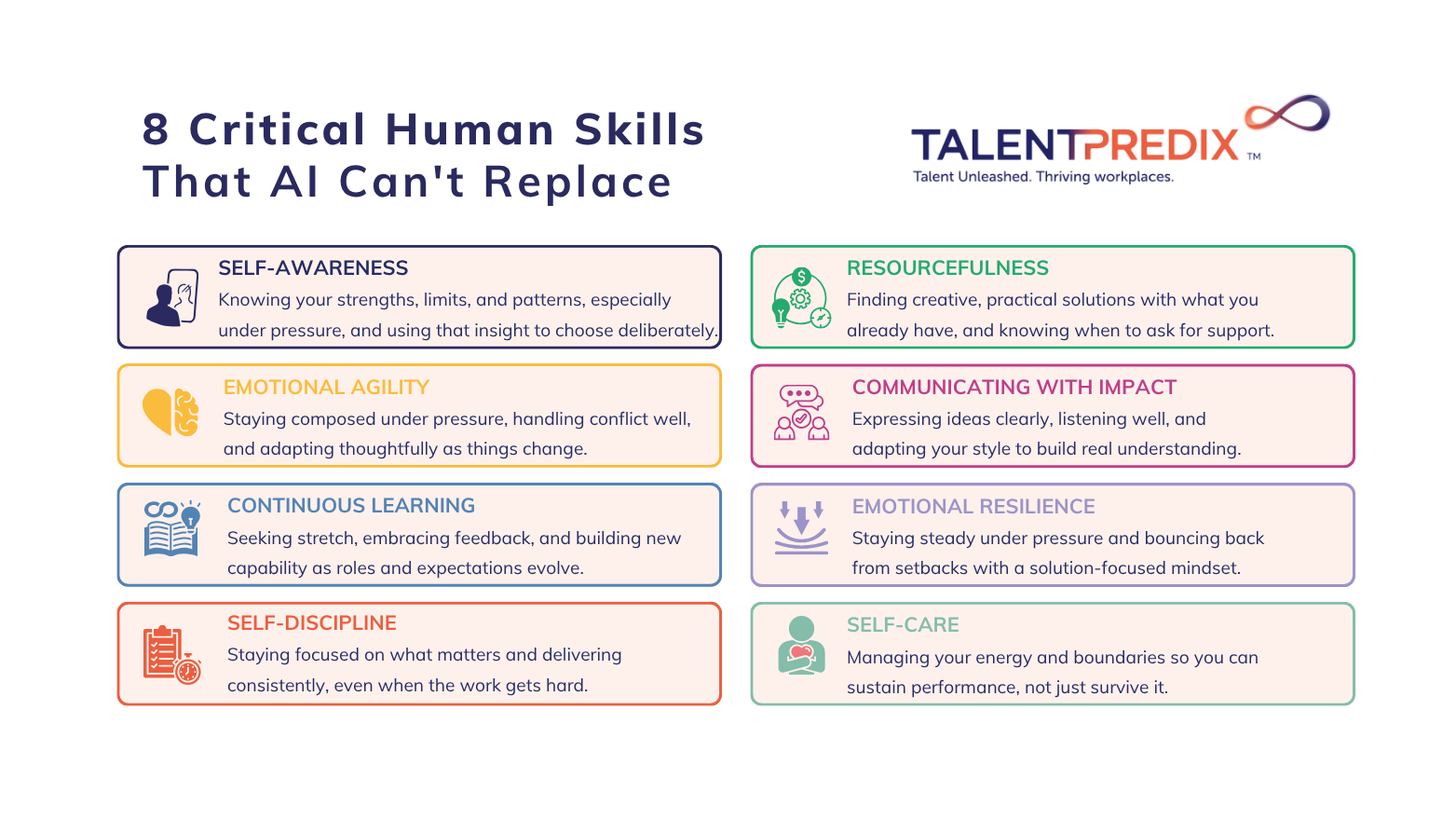
At TalentPredix™, we define resourcefulness as one of the eight Self-Mastery skills – the critical human skills that allow people to perform, adapt, and thrive in the Age of AI. Specifically, it’s about identifying creative, practical solutions using the knowledge, tools, and networks already available to you. It’s adapting quickly to new situations, asking insightful questions, and leveraging support to overcome obstacles effectively.
In other words, resourcefulness is what turns “we don’t have what we need” into “here’s what we can do with what we’ve got.”
Resilience helps us absorb shocks and bounce back. Resourcefulness helps us find a way through in the first place.
The two are deeply connected – research on organizational resilience increasingly frames resourcefulness as a core behavioural dimension of resilience itself, alongside agility in unexpected situations and the ability to adapt routines and reallocate resources when conditions shift. Research from Gallup also highlights the importance of helping people use their strengths effectively to improve performance and adaptability.
This matters because uncertainty rarely arrives as a single dramatic event. More often, it shows up as a steady stream of smaller ambiguities – shifting priorities, incomplete information, new tools, unclear instructions. Resourcefulness is the skill that keeps people moving productively through all of that noise, rather than waiting for clarity that may never fully arrive.
There’s also a strong theoretical basis for why resourcefulness fuels motivation under pressure. Conservation of Resources theory, one of the most influential frameworks in organizational psychology, holds that people are fundamentally motivated to protect and build up the resources – strengths, skills, knowledge, relationships, tools – that help them cope with stress and pursue goals. Resourcefulness is essentially this theory in action: it’s the active, deliberate process of mobilising, combining and strengthening resources, rather than passively waiting for the right conditions to appear. When people feel capable of generating options for themselves, motivation tends to follow.
As AI takes over more routine, information-processing tasks, the value of resourcefulness only grows.
AI can generate options, summarise information, and surface possibilities at speed – but someone still has to decide which option fits the situation, ask the right follow-up question, or combine an AI output with a piece of tacit knowledge that only a human would think to apply.
That’s resourcefulness at work: using all available tools and resources, including AI itself, creatively and practically to solve real problems.
Like all Self-Mastery skills, resourcefulness isn’t fixed.
Developing resourcefulness at work requires more than resilience training alone.
It can be developed through deliberate practice: rotating people through unfamiliar challenges and stretch opportunities, encouraging them to ask “what do we already have that could help here?”, and creating environments where experimentation and creative problem-solving are genuinely encouraged and safe.
Organizations that develop resourcefulness alongside resilience build something powerful – people who don’t just survive uncertainty, but actively find their way through it. Organizations that strengthen resourcefulness at work create people who can adapt, solve problems, and thrive through uncertainty. In a world where change is constant and answers are rarely handed to us, that might be the most powerful human skill of all.
Resourcefulness is one of eight Self-Mastery skills measured in the TalentPredix™ 360, the only assessment that reveals Strengths, Motivations, Values, and Critical Human Skills together.
See how resourcefulness and the other seven Self-Mastery skills show up across your organization. Request a free trial or view a sample profile to see it in action.
This is the first post in our Self-Mastery Series. Each week, we’re breaking down one of the eight skills, what it means, why it matters, and how to build it deliberately. Next up: Emotional Agility.
Most leadership development was built for a more stable world.
That world no longer exists.
AI, constant change, hybrid work, and rising workforce expectations are reshaping what great leadership requires. Leaders now need the human skills, self-mastery, adaptability, and strengths-based insight to help people perform, adapt, and thrive through uncertainty.
This TalentPredix™ White Paper explores what makes a great leader in the Age of AI – and what organizations need to assess, develop, and measure to build future-ready leadership capability.
Inside, you’ll discover:
For HR, Talent, L&D, OD, and People leaders, this is a practical guide to developing leaders who can unlock potential, strengthen culture, and drive lasting performance.
AI is changing how work gets done.
The bigger performance risk is what happens to judgment, focus, resilience, and collaboration when pressure rises and change never stops.
Most organizations are investing in digital capability. Far fewer are measuring or building the human capabilities that determine whether AI creates advantage or accelerates burnout.
This White Paper sets out a practical, evidence-based case for treating self-mastery as a strategic capability, not a “nice to have”.
Inside you’ll find:
If you lead HR, Talent, L&D, transformation, or organizational performance, this will help you turn intent into action.