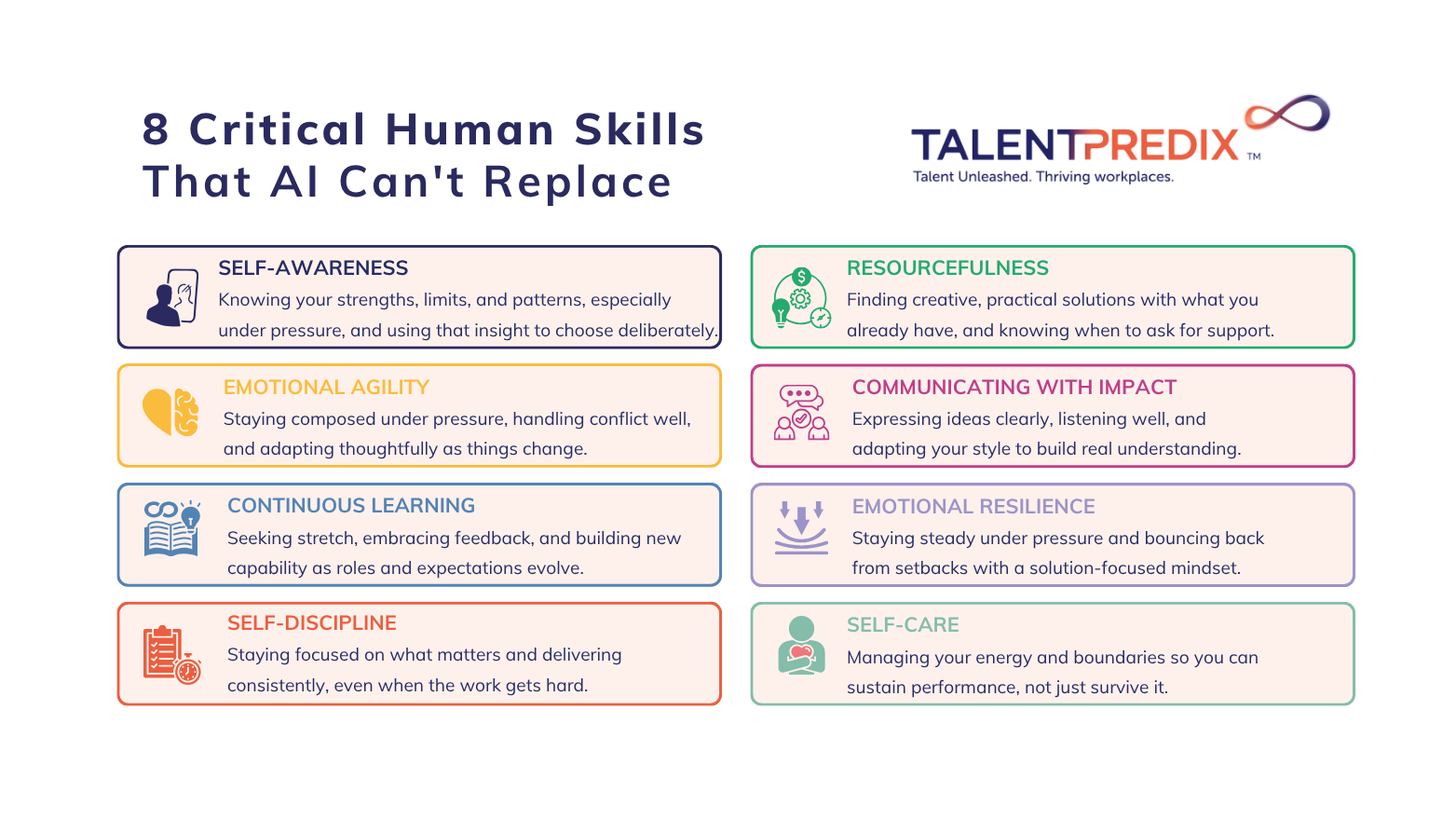
Resourcefulness at work is becoming one of the most important human skills in the Age of AI.
Resilience gets all the headlines. It’s the word HR and leaders reach for when they talk about navigating uncertainty, change, and pressure.
However, there’s a quieter capability working alongside it – one that rarely gets the spotlight, despite being just as important: resourcefulness.
At TalentPredix™, we define resourcefulness as one of the eight Self-Mastery skills – the critical human skills that allow people to perform, adapt, and thrive in the Age of AI. Specifically, it’s about identifying creative, practical solutions using the knowledge, tools, and networks already available to you. It’s adapting quickly to new situations, asking insightful questions, and leveraging support to overcome obstacles effectively.
In other words, resourcefulness is what turns “we don’t have what we need” into “here’s what we can do with what we’ve got.”
Resilience helps us absorb shocks and bounce back. Resourcefulness helps us find a way through in the first place.
The two are deeply connected – research on organizational resilience increasingly frames resourcefulness as a core behavioural dimension of resilience itself, alongside agility in unexpected situations and the ability to adapt routines and reallocate resources when conditions shift. Research from Gallup also highlights the importance of helping people use their strengths effectively to improve performance and adaptability.
This matters because uncertainty rarely arrives as a single dramatic event. More often, it shows up as a steady stream of smaller ambiguities – shifting priorities, incomplete information, new tools, unclear instructions. Resourcefulness is the skill that keeps people moving productively through all of that noise, rather than waiting for clarity that may never fully arrive.
There’s also a strong theoretical basis for why resourcefulness fuels motivation under pressure. Conservation of Resources theory, one of the most influential frameworks in organizational psychology, holds that people are fundamentally motivated to protect and build up the resources – strengths, skills, knowledge, relationships, tools – that help them cope with stress and pursue goals. Resourcefulness is essentially this theory in action: it’s the active, deliberate process of mobilising, combining and strengthening resources, rather than passively waiting for the right conditions to appear. When people feel capable of generating options for themselves, motivation tends to follow.
As AI takes over more routine, information-processing tasks, the value of resourcefulness only grows.
AI can generate options, summarise information, and surface possibilities at speed – but someone still has to decide which option fits the situation, ask the right follow-up question, or combine an AI output with a piece of tacit knowledge that only a human would think to apply.
That’s resourcefulness at work: using all available tools and resources, including AI itself, creatively and practically to solve real problems.
Like all Self-Mastery skills, resourcefulness isn’t fixed.
Developing resourcefulness at work requires more than resilience training alone.
It can be developed through deliberate practice: rotating people through unfamiliar challenges and stretch opportunities, encouraging them to ask “what do we already have that could help here?”, and creating environments where experimentation and creative problem-solving are genuinely encouraged and safe.
Organizations that develop resourcefulness alongside resilience build something powerful – people who don’t just survive uncertainty, but actively find their way through it. Organizations that strengthen resourcefulness at work create people who can adapt, solve problems, and thrive through uncertainty. In a world where change is constant and answers are rarely handed to us, that might be the most powerful human skill of all.
Resourcefulness is one of eight Self-Mastery skills measured in the TalentPredix™ 360, the only assessment that reveals Strengths, Motivations, Values, and Critical Human Skills together.
See how resourcefulness and the other seven Self-Mastery skills show up across your organization. Request a free trial or view a sample profile to see it in action.
This is the first post in our Self-Mastery Series. Each week, we’re breaking down one of the eight skills, what it means, why it matters, and how to build it deliberately. Next up: Emotional Agility.
Your skills strategy is more sophisticated than it’s ever been. Your talent outcomes probably aren’t keeping pace. Here’s why.
The skills-based organization has become the dominant talent model of the moment, and for good reason. Moving away from rigid competency frameworks and job-title-defined roles toward a more fluid, capability-led approach to workforce design is genuinely the right direction.
It creates transparency, enables non-linear career paths, and gives organizations the agility to respond when priorities shift.
But there’s a gap in how most organizations are implementing it. And that gap is quietly undermining the results they’re expecting.
In the first episode of Talent Trailblazers, James Brook and Karen Stone get to the heart of it: skills tell you what someone can do. They don’t tell you what someone will do brilliantly, sustainably, and with genuine energy.
For that, you need strengths. And right now, most skills-based talent strategies are missing them entirely.
Traditional competency frameworks were too rigid, built around fixed role profiles that couldn’t adapt fast enough to a rapidly changing environment. Skills-based approaches rightly challenged that.
But in replacing one incomplete model with another, many organizations have simply swapped one blind spot for a different one.
Consider two employees with identical skills profiles being considered for the same internal role. Same technical capability, same track record, same qualifications.
One is naturally energized by the kind of work that role demands, the ambiguity, the stakeholder complexity, the need to build something from scratch.
The other performs reliably in structured environments but drains quickly when the ground shifts beneath them. A pure skills match treats them as equivalent candidates.
In practice, one will thrive. One will struggle. And the organization won’t know which until it’s too late.
This is exactly what we explored in Why Skills Alone Won’t Unlock Internal Mobility.
The moment when the skills + strengths combination creates most value is precisely when someone is being considered for a new role, a stretch assignment, or a development pathway.
That’s when knowing what someone can do without knowing what energizes and sustains them leads to the wrong call.
“Replacing a rigid competency model with a skills framework is progress. However, it’s only half the answer. The other half is understanding the underlying human strengths and qualities that determine whether those skills get deployed at their best.”
James Brook, Founder, TalentPredix™
A useful way to think about this is the iceberg model of talent. Skills sit above the waterline. They’re visible, measurable, and increasingly well-documented in skills frameworks and talent systems across the world.
They’re what organizations have traditionally used to make hiring, promotion, and development decisions, and they’re the foundation of the skills-based organization movement.

But below the waterline sits everything that actually drives how those skills get used. A person’s strengths, the activities that genuinely energize them and where they produce their best work. Their motivations, the underlying drivers that determine whether they bring discretionary effort or just enough. And their values, the principles that shape how they work, what they’ll commit to, and where they’ll thrive or struggle culturally.
The iceberg below the waterline is larger than what’s above it. And it’s what determines whether the skills you can see on a profile translate into the performance you actually need.
Most talent systems are built to assess the tip of the iceberg. The skills-based organization improves how we map and deploy that visible portion. But without the depth, without understanding what sits below the waterline for each person, organizations are still making critical talent decisions with half the picture.
As James and Karen explore in the podcast, strengths are the power source behind skills. They’re the natural energizers that explain why two people with identical capability profiles produce fundamentally different results, in performance, in resilience, in the quality of what they build and the teams they grow around them.
When organizations integrate strengths data alongside skills, three things change.
Talent decisions become more precise. Roles that demand creative problem-solving, relationship-building, or driving change through uncertainty are filled more effectively when those natural strengths are part of the matching criteria. Not as a replacement for skills, but as the layer that predicts engagement, growth trajectory, and whether someone will still be performing at their best eighteen months in.
Development becomes more meaningful. Employees who understand their strengths make better decisions about which opportunities to pursue and why. Internal mobility shifts from a reactive response to a vacancy into an active, ongoing conversation about where someone can contribute most and grow fastest. LinkedIn data shows that employees at companies with strong internal mobility stay nearly twice as long, and that effect is amplified when moves are strengths-aligned.
Organizational agility increases. A workforce that understands its collective strengths can be deployed more intentionally through disruption, whether that’s technological change, structural transformation, or the relentless pressure of a competitive market. That’s the difference between a skills-based organization and a genuinely future-ready one.
James and Karen are direct about the failure mode they see most often: organizations treating strengths as a one-off initiative rather than a strategic operating system.
A workshop. An assessment at onboarding. A team session that generates interesting conversations and then gets filed away. These aren’t without value, but they’re not what a strengths-led organization actually looks like.
The organizations getting this right have made strengths insight continuous, embedded into how roles are designed, how performance is discussed, how people are matched to opportunities, and how managers coach their teams every day.
And they’ve invested in equipping those managers to use the data, because the most sophisticated talent framework in the world delivers nothing if the people closest to the talent don’t know how to act on it.
Building a future-ready organization isn’t about replacing your competency framework with a skills inventory. It’s about going deeper, understanding the human qualities that determine whether skills become performance, and whether performance becomes something that lasts.
Tired of talent strategies that look good in theory but fail to shift real performance? The issue may not be your skills framework. It may be what it leaves out.
TalentPredix™ helps organizations see the full picture – strengths, motivations, values, skills, and behaviours – so they can make smarter decisions about development, mobility, leadership, and team performance.
Ready to explore what a strengths + skills approach could mean for your organization? Watch the full Talent Trailblazers episode, read Why Skills Alone Won’t Unlock Internal Mobility, or request a free TalentPredix™ trial.
Every leader I speak to right now is somewhere on the same spectrum: either cautiously optimistic about AI, quietly overwhelmed by it, or both simultaneously. And that tension – that contradictory experience of feeling more capable and more exhausted at the same time – turns out to be exactly what the research is uncovering.
We’ve been told the story of AI as relief. Less admin. Faster decisions. More time for the strategic, human work that matters. It’s a compelling narrative. But a growing body of evidence suggests it’s an incomplete one – and for leaders in particular, the gap between the promise and the reality deserves serious attention.
A landmark study published in Harvard Business Review by Aruna Ranganathan and Xingqi Maggie Ye found something striking: when a 200-person tech company gave employees access to generative AI tools, they didn’t work less. They worked more – at a faster pace, across a broader range of tasks, and deeper into their evenings. Nobody asked them to. They just did, because AI made doing more feel possible.
“You had thought that maybe, because you could be more productive with AI, you save some time, you can work less. But then really, you don’t work less. You just work the same amount or even more.”
— Engineer, quoted in HBR study on AI and work intensification
The study identified three distinct patterns: task expansion (people absorbing work that would previously have gone to others), blurred work-life boundaries (AI made starting a task so frictionless that workers slipped prompts into lunch breaks and late evenings), and constant multitasking (managing multiple AI threads simultaneously, creating cognitive load even as it felt productive). The result was a self-reinforcing cycle: AI accelerated tasks, which raised expectations for speed, which created greater reliance on AI, which widened scope further.
This lands on leaders who were already struggling. Research by Oracle cited in a second HBR study found that 85% of business leaders have experienced decision stress, with three-quarters reporting a tenfold increase in daily decisions over the previous three years. Poor decision-making is estimated to cost firms at least 3% of profits annually – and that’s before we factor in the reputational costs of a single poorly handled crisis.
There’s a deeper paradox at work here. AI gives leaders access to more data, more analysis, and more options than ever before. But more isn’t always better. In practice, the cognitive load of processing vast amounts of information – much of it beyond what you actually need to make a sound decision – is itself a significant source of pressure. Research consistently shows that decision quality degrades as the volume of information increases past a certain threshold.
AI can surface fifty data points where five would suffice, and the effort required to evaluate, filter, and contextualise all of it quietly drains the very capacity leaders need for clear-headed judgment. The result is what researchers call decision fatigue: the more choices and information you process, the poorer your subsequent decisions become. AI, paradoxically, can intensify exactly the problem it promises to solve.
DDI’s Global Leadership Forecast 2025 found that 71% of nearly 11,000 leaders reported rising stress levels since taking on their current role – up from 63% in 2022. Successfully leveraging AI was cited as a top stressor by 29% of respondents. In other words, the very tool meant to relieve pressure is now a source of it.
“AI doesn’t just give you more information – it gives you more than you can act on. And more data without better judgement doesn’t improve decisions; it just makes poor ones feel more justified. The leaders who get the most from AI aren’t the ones who use it most. They’re the ones who know what question they’re trying to answer before they ask it – and who bring the human judgement to know what the answer actually means.”
— James Brook, TalentPredix™
What makes this particularly tricky for leaders is that the overload is largely invisible – to themselves and to their organizations. Because employees are expanding their workloads voluntarily, and framing it as energising experimentation, it rarely registers as a problem until it becomes one. A 2026 ActivTrak analysis confirmed the pattern: after AI adoption, task volume and multitasking rose while focused work fell. Burnout isn’t just driven by hours worked – it’s driven by fragmentation, decision fatigue, and lack of recovery time.
Meanwhile, the DHR Global Workforce Trends Report 2026 found 83% of workers reporting at least some degree of burnout, with burnout’s influence on engagement growing sharply – 52% of workers now say burnout drags down engagement, up from 34% in 2025. At the same time, ManpowerGroup’s Global Talent Barometer 2026 found AI adoption jumped 13% while confidence in using AI fell 18%. The tools are spreading faster than the support structures around them.
The HBR research on decision-making under pressure makes clear that AI genuinely can help – as a sounding board, a co-pilot for synthesising complex risk data, a tool for stress-testing decisions before you commit. The question is whether it’s being deployed intentionally, or just absorbed into the existing pressure. Here’s what the research, and hard-won experience, suggests good leadership looks like in practice.
Not slow-downs, but structured moments to check alignment and absorb information before pressing forward. AI removes friction, which is mostly good, but friction sometimes served a purpose. A quick decision pause before a major commitment – one counterargument, one explicit link to your strategic goals – can prevent the kind of drift that only becomes visible in hindsight.
The blurring of work and non-work is one of the most consistent findings across the research. Because AI makes it so easy to start a task, people stop stopping. Leaders need to model clear boundaries – no prompting during lunch, no ‘quick last query’ at 10pm – and build team norms that make it safe to switch off. Deloitte’s 2025 Workforce Intelligence Report identified cognitive strain and decision friction as the leading indicators of burnout, ahead of workload volume for the first time. Boundaries aren’t soft; they’re structural and vital for effective performance.
There’s a subtle but important shift that happens when AI moves from tool to authority – when its outputs stop being inputs to your thinking and start being the answer. Leaders need to actively resist this. AI works best when it serves the human agenda, not the other way around. That means using it to interrogate your assumptions, not validate them; to widen your options, not close them down. As one expert framed it in the HBR decision-making research: AI functions best as a teammate that challenges your thinking – not an oracle that ends it. The moment your team stops questioning AI outputs is the moment the risk quietly rises.
AI gives you one synthesised perspective. It draws on patterns in data; it doesn’t draw on lived experience, organizational context, or the kind of judgment that comes from genuinely knowing your people. The 2025 Wiley Workplace Intelligence research found that the traits most predictive of high-performing teams were emotional intelligence, psychological safety, and trust – none of which AI can replicate or replace. The leaders who are getting this right are those who use AI to free up time for human connection, not replace it. Short check-ins, shared reflection, real dialogue – these aren’t soft extras. They’re what makes the rest of it work.
Good leaders have always known when to stop gathering data and start deciding. AI makes that discipline harder to maintain, because the next analysis is always only a prompt away. Build the habit of asking: what information do I actually need to make this call? More often than not, you already have it. The rest is noise that costs you focus.
The question facing leaders isn’t whether AI will change how you work. It already has. The question is whether you’re actively shaping that change – or letting it quietly shape you. The data suggests most of us are closer to the latter than we’d like to admit. That’s not a criticism; it’s an invitation.
Feeling the pressure to make faster, better people decisions with less room for error?
The answer is not more data for the sake of it. It is better insight into what helps people perform, adapt, and thrive.
TalentPredix™ helps organizations understand the strengths, motivations, values, and human capabilities their people need to lead well through constant change.
If you want to build more human, future-ready leadership in the Age of AI, book a demo or get in touch with TalentPredix™.
AI Doesn’t Reduce Work – It Intensifies It – HBR, February 2026
How AI Can Help Leaders Make Better Decisions Under Pressure – HBR, October 2023
Why Leaders Need to Build Resilience to Avoid AI Burnout – IT Pro, March 2026
Is AI Helping Burnout or Quietly Making It Worse? – HRD Connect, March 2026
Workforce Trends 2026: Leaders Confront Burnout, Disengagement and AI-Driven Change – DHR Global / Hunt Scanlon, November 2025
Takeaways for 2026: About Stress, Change, People and Performance – Wiley Workplace Intelligence, 2025
The world of work has always demanded capable leaders. What has changed – dramatically, and permanently – is the nature of the water they are navigating.
It is no longer a steady river with the occasional rapid. It is white water: relentless, unpredictable, and flowing from multiple directions at once. AI transformation, multi-generational workforces, conflicting demands, hybrid working, geopolitical instability and stakeholder expectations that would have seemed extraordinary a decade ago are now the simultaneous daily reality of leadership.
And yet the global leadership development industry – valued at $370 billion – continues, in the main, to prepare leaders for calmer conditions. One-size-fits-all programmes. Deficit-based competency frameworks. Development that tells leaders what they are getting wrong but rarely builds the inner resources they need to keep performing when everything around them keeps shifting.
Here is what navigating white water actually demands – of leaders, and of the organizations that develop them.
Transformation is no longer a project with a start and an end date. It is a permanent condition. The leaders who will thrive in it are not those who manage change most efficiently – they are those who adapt most effectively, and who draw the best from the people around them as conditions shift.
That requires a different kind of leadership development. Not one that identifies what is broken and tries to fix it. One that uncovers what is distinctive in each leader – their specific combination of strengths, motivators and values – and builds from that foundation.
Positive, adaptive leadership is not a style. It is a set of capabilities: the ability to inspire purpose under uncertainty, to model learning agility, to empower others with genuine autonomy, and to align diverse strengths toward shared goals. These cannot be downloaded from a generic competency framework. They emerge when development is built around who each leader actually is.
Leaders who know and operate from their strengths maintain composure, make better decisions and recover faster when things go wrong. In the age of AI, where the pace of change will only accelerate, that inner resourcefulness is not a development aspiration. It is a survival capability.
“In the age of AI, inner resourcefulness is not a development aspiration. It is a survival capability. The leaders who will thrive are those who know what they uniquely bring – and have built the self-insight and standout strengths to deploy it, whatever the conditions.”
– James Brook, Founder & CEO, TalentPredix™
High performance in turbulent conditions is not a solo endeavour. It is built in teams – and the quality of those teams depends almost entirely on the culture the leader creates around them.
Google’s Project Aristotle research identified psychological safety as the single biggest factor in team performance: more predictive than the intelligence, experience or technical capability of the individuals within it. When people feel safe to speak up, to challenge, to be honest about what is not working, the team shares perspectives, thinks better and adapts faster.
But psychological safety does not emerge by accident. It is built – through how leaders respond to mistakes, how they handle disagreement, and whether they create genuine space for diverse perspectives and ideas. Leaders who build trust and belonging in their teams are not being soft. They are building the conditions for their teams to perform at their best precisely when the pressure is highest.
Belonging matters beyond safety. When people feel valued for who they are – not just what they produce – they bring more of their genuine capabilities to their work. In a world where the most valuable contributions are creative, adaptive and relational, that is a significant competitive advantage.
The shift from compliance culture to one of genuine collaboration and inclusion is one of the most strategically important leadership transitions of our time. It cannot be mandated from the top.
It must be modelled.
This is especially urgent given that 75% of Gen Z prioritise values-aligned work over pay and are actively turning down management roles that lack genuine purpose. The next generation of leaders will follow those who model it – or they won’t follow at all.
The evidence on what happens when leaders genuinely invest in the strengths and potential of their people is not ambiguous. Gallup’s research on strengths-based organizations consistently finds substantial performance gains across every metric that matters commercially.
10–19%
increase in sales
26–72%
lower staff turnover in high-attrition organizations
22–59%
fewer safety incidents
These are not wellbeing outcomes. They are business outcomes – and they result from one thing: leaders who create conditions where people can perform at their best.
But performance alone is not enough. The organizations that will sustain growth through the disruption ahead are those whose leaders connect what people do to why it matters. Purpose is not a values statement on a wall. It is the lived experience of understanding how individual contributions connect to something meaningful – to customers, to communities, or to a mission worth pursuing.
Leaders who set a clear, compelling direction and then invest in developing the distinctive strengths of everyone around them do not just improve short-term performance. They build the creative energy and intrinsic motivation that generate lasting innovation and durable competitive advantage.
In 2004, psychologist Fred Luthans and colleagues published what remains one of the most important insights in organizational psychology: that alongside human capital (“what you know”) and social capital (“who you know”), there is a third and critically underinvested form of capital that determines how effectively leaders show up and perform under pressure.
He called it psychological capital. And he defined it as the positive inner resources that enable people to sustain high performance through adversity, uncertainty and constant change.
“Who I am is every bit as important as what I know and who I know.”
– Fred Luthans, Business Horizons, 2004
Psychological capital comprises four specific, developable resources – what Luthans called the HERO within each of us.
Hope: the ability to set goals and find multiple pathways to reach them.
Efficacy: genuine confidence in one’s capacity to take on challenge.
Resilience: the ability to recover from adversity with learning rather than depletion.
Optimism: not naïve positivity, but realistic, constructive expectation about the future.
The critical insight is this: these resources are not fixed. They are state-like. They can be developed – and they can be depleted. Research is clear that sustained pressure without adequate support and development erodes them. Leaders who are high in PsyCap sustain performance where others deplete. They navigate ambiguity with composure. They model the resilience and agility their teams need to see.
Leaders who operate from their genuine strengths, and help team members do the same, access their HERO resources more readily – and strengths-based development is one of the most reliable ways to build all four.
This is not a case for ignoring weaknesses or avoiding tough conversations. It is a case for investing in the psychological infrastructure that makes every other leadership capability more sustainable. In white water conditions, leaders need more than knowledge and networks. They need the inner resources to keep leading effectively when the ground keeps shifting.
The question for every organization is no longer whether leadership development matters. It is whether you are building the right kind for this new era we are entering.
“Leaders have invested heavily in what people know and how they work with others. The next frontier is helping people become psychologically and emotionally stronger, individually and collectively – so they can perform, adapt and thrive under pressure.”
– James Brook, Founder & CEO, TalentPredix™
Explore how TalentPredix™ can help your organization develop leaders equipped for constant change. Request a free trial or book a discovery call to find out more.
James Brook | TalentPredix™ | April 2026
AI can write your session notes. It can track your client’s goals, spot patterns across conversations, and generate a development plan before you’ve had your first coffee. It’s fast, tireless, and getting better every month.
So here’s the uncomfortable question: if AI can do all of that, what exactly are you for?
I’ve been sitting with this question for a while. And I think most of us in the coaching profession are answering it the wrong way. We’re pointing at AI’s limitations – “it can’t feel, it can’t truly listen, it can’t build real trust” – and using them as reassurance. ‘See? We’re still needed.’
That’s the wrong conversation.
The right conversation is this: are you actually delivering what only a human can deliver? Because the research is unambiguous on what that looks like – and it’s a high bar.
In controlled trials, AI-generated responses are sometimes rated as more empathic than those written by humans. And yet when people know they’re talking to a machine, they consistently report feeling less understood – even when the words are identical. The neuroscience is clear: human connection activates something biological. Mirror neurons, oxytocin, dopamine. These aren’t metaphors. They’re mechanisms. No algorithm touches them.
Bill Campbell – the Trillion Dollar Coach – didn’t build his reputation on technique. His colleagues described his method simply as love. Unconditional care for the person in front of him. That’s what made radical honesty feel safe rather than threatening. You either have that or you don’t. Clients – especially senior ones – know the difference.
Most of the problems clients bring us aren’t well-defined. They’re contradictory, ambiguous, loaded with competing pressures – and the client often can’t see clearly because they’re standing inside the problem. A skilled coach doesn’t hand them a framework. They sit alongside them in the mess, helping them slow down, surface what they’re actually assuming, question beliefs they’ve never examined, and weigh choices against what they genuinely value – not what looks good on paper.
That process is inherently human. It requires curiosity without agenda, the ability to hold contradictions without rushing them to resolution, and the moral seriousness to engage with the ethical dimensions of a decision rather than optimise around them. AI can generate options. It can map scenarios. What it cannot do is help someone discover that the reason they keep avoiding a particular choice is rooted in a belief about themselves they’ve never said out loud.
That’s the work. And it only happens in the presence of another human being who is paying full attention.
It can send you a reminder. It cannot make you feel the mild discomfort of knowing that someone who genuinely cares about your growth is going to ask you about it. That discomfort is not a flaw in the coaching relationship. It’s the mechanism.
Marshall Goldsmith’s feedforward discipline is worth stealing here. End every session with one precise, forward-facing question – What will you do specifically and differently this week? – then go completely silent. Most coaches fill that silence. The silence is the work.
The warmth of a coaching relationship can quietly become a comfort zone – for the client, and for the coach. If you’re avoiding a difficult conversation to preserve the connection, you’re not serving your client. You’re serving yourself.
The rise of AI isn’t just a challenge to our profession. It’s an invitation to honest self-examination. The bar is rising. The coaches who will thrive aren’t those who point at what AI can’t do. They’re the ones ruthlessly honest about what they themselves are – and aren’t – bringing.
That’s a harder question. But it’s the right one.
I’ve written a full guidance document on this – covering the five things AI cannot coach, the self-mastery framework every coach needs, and the lessons from Goldsmith and Campbell that most CPD programmes won’t give you.
To request a copy, contact us at info@talentpredix.com or speak to us about TalentPredix™ Practitioner Certification.
Explore Practitioner Certification
Request a Free Trial
You last had a proper career conversation with one of your team… when exactly?
If you’re struggling to remember, you’re not alone — and you’re not the problem. You’re a manager juggling a dozen competing priorities, and career development is the thing that always gets bumped. It feels important. It never feels urgent. And so it waits.
But here’s what’s waiting alongside it: your best people, quietly updating their CV.
Only 15% of employees have regular career growth conversations with their manager.
Read that again. 15%.
A separate survey found that 53% of employees want more career conversations with their manager — but say their managers are simply too busy to have them. (CFO.com)
And the cost of this gap? It’s huge!
93% of employees say they are more likely to stay with an organization that invests in their career development. (Thirst) Meanwhile, 74% of Millennial and Gen Z employees say they would leave if not given enough opportunities for skills development. (Inspirus) In exit interviews across more than 20,000 cases, lack of career growth remains one of the leading drivers of turnover. (HiBob)
Career and growth opportunities are not a “nice to have”. They are arguably the single most important factor in attracting, retaining and getting the very best from people.
Here’s the uncomfortable truth: even with the best intentions, most managers are not equipped to lead career development conversations — and it’s not their fault.
Nearly half of all employees say their manager doesn’t know how to help them with career development. Research by Right Management found that two-thirds of managers are failing to support their employees’ career growth. (ManpowerGroup)
Before the AI era, managers were already overwhelmed. Many are simultaneously individual contributors and people managers, constantly pulled between tactical delivery and long-term development — and it is always the former that wins, because that is what gets measured and rewarded. Career planning becomes, at best, a nice-to-have.
Now add AI transformation reshaping roles, workflows and skill requirements almost overnight. Managers have even less bandwidth. Expecting them to function as skilled career coaches — even with training — is no longer realistic. It was perhaps always an unrealistic ask.
“Just as elite athletes need specialist coaches, not just their team manager, employees deserve dedicated career experts — not an overwhelmed line manager squeezing in five minutes between meetings.”
— James Brook, Founder, TalentPredix™
Think about how elite sport works.
A Premier League footballer doesn’t rely on their head coach for nutrition advice, mental resilience training, biomechanics analysis and contract strategy. They have specialist coaches for each. The head coach focuses on what they do best: performance on the pitch, team dynamics, game-day decisions.
Why do we expect anything different in organizations?
The manager’s role is not to be all things. It is to coach for day-to-day performance: offering feedback, encouragement, support and accountability. Career development — the deeper work of exploring options, mapping strengths, building individual development plans, navigating internal mobility — requires a different kind of specialist.
When we free managers from the pressure of being career coaches, we let them play to their own strengths. Everyone wins.
A senior manager — talented, committed, genuinely invested in her team — told us recently that she hadn’t had a proper career conversation with any of her direct reports in over six months. Not because she didn’t care. Because every week, something more urgent won.
Three months later, one of her highest-potential team members resigned. In the exit interview, the reason was simple: “I didn’t feel like anyone was invested in where I was going.”
That manager was devastated. She had assumed good intentions were enough. They weren’t. And she had never been given the tools, the time, or the specialist support to do this well.
In my experience, this is not an isolated story. It is the norm.
Organizations that get this right are not necessarily spending more. They are spending smarter — engaging specialist career coaches and business psychologist to deliver tailored, scalable career development services alongside line management.
This can include one-to-one career coaching, strengths and skills mapping, structured career development workshops, and support with internal mobility conversations. Done well, these services generate something else of enormous value: rich, aggregated, anonymised insight into employee engagement and career progress — insight that is far more dynamic and useful than an annual ‘tick box’ engagement survey.
The business case is not complicated. Career development is a lever for performance, retention and organizational resilience. The organizations that invest in it don’t just keep their best people longer — they build the kind of culture that attracts great people in the first place.
The question is no longer whether to invest in career development. It’s who is best placed to lead it.
Our Career Development Plans are built around exactly the model described in this article: specialist-led, strengths-based, and designed to free managers up rather than add to their load.
Three plans for organizations of 20 to 500+, covering strengths assessment, career coaching, development workshops, and talent intelligence reporting — following the same proven four-stage journey: Assess, Develop, Coach, Measure.
Explore Career Development Plans →

Or book a free 30-minute discovery call and we’ll walk you through what would work for your organization specifically.
Most organizations are investing in skills. Far fewer are asking what helps people use those skills at their best.
In this first episode of Talent Trailblazers, James Brook and Karen Stone explore why strengths matter just as much as skills when organizations want to build agility, engagement, performance, and a more future-ready workforce. They discuss why strengths are the natural energizers behind sustainable performance, what makes a strengths-based organization different, and how leaders can deploy talent more intentionally across individuals and teams.
Skills matter – but skills alone do not explain where people perform at their best, stay energized, or have the greatest potential to grow.
That is where strengths matter. In this episode, James and Karen explore why strengths act as the power source behind performance, resilience, innovation, and engagement – and why organizations need a strengths- and skills-based approach, not just a skills-based one.
They also unpack what stops organizations getting this right: treating strengths as a one-off initiative, failing to equip managers, or misunderstanding strengths as surface-level positivity instead of a serious performance and culture strategy.
TalentPredix™ helps organizations uncover strengths, human skills, values, and motivators so they can make better decisions about hiring, development, leadership, team performance, and transformation.
Request your free trial or book a short conversation.

We recently analysed TalentPredix™ assessment data from 230 HR and L&D professionals across the UK.
The dataset spans managers and non-managers, and includes talent profiles, career drivers, and values. The findings are both practically useful and, in a few places, genuinely provocative.
But data without context is just numbers. What makes this analysis interesting is what it means when you place it against the moment HR is actually living through.
According to Gartner, only 24% of HR leaders believe their current structure appropriately separates transactional from strategic work. Deloitte found that 88% of change initiatives fail not because of flawed strategy, but because leaders underestimate the human psychology of change. And Josh Bersin’s 2026 analysis is unambiguous: a massive, AI-driven reinvention of HR has begun.
The question is whether the profession has the talent profile to meet that moment.
Here is what the data tells us.
Understanding Others is the most frequently occurring top talent across the entire sample, sitting well ahead of everything else. Drive, Self-development, and Positive Energy follow closely. Together, this is the portrait of a profession that is empathy-led, growth-oriented, and people-energised.
That profile is a genuine asset. Gallup research across nearly 50,000 business units found that strengths-based management improves engagement by 15% and profitability by up to 29%.
HR professionals who lead from their natural empathy and drive are better positioned to build the psychological safety that Amy Edmondson’s research identifies as the single greatest predictor of team performance — and the essential condition for successful AI adoption.
But here is the risk.
People functions that are heavily weighted toward relationship and delivery can underinvest in the more analytically demanding capabilities the AI era now requires: critical thinking, data-driven decision-making, forward planning, and the ability to make the financial case for human capital investment.
My white paper on HR transformation argues that effective CHROs today need to operate as Strategic Business Partners and People Economists — making the numbers-backed case for people investment, not just the values-based one.
The talent data suggests this capability is currently underdeveloped in the profession.
Female professionals — who make up 79% of the sample, reflecting the broader composition of the HR workforce — show a stronger concentration in Connecting talents (36.5%) compared to male colleagues (24.9%).
Understanding Others, Ownership, and Organization feature prominently, pointing to a style centred on support, follow-through, and interpersonal effectiveness.
Male profiles lean more toward Navigating Change (29.8%) and Problem Solving (26.5%), with Drive, Creativity, and Decisiveness appearing more prominently.
Not better, not worse — a genuinely different profile.
The strategic implication is significant.
The white paper identifies seven roles that define effective CHROs today, including Chief Change Architect and Chief Humanising Officer. The first demands exactly the challenge-oriented, analytically confident strengths that appear more frequently in male profiles. The second draws heavily on the empathy, relationship-building, and developmental orientation more prevalent in female profiles.
The most effective HR leadership teams are those that make deliberate use of both patterns rather than defaulting to one dominant style.
The manager vs non-manager split is broadly healthy.
Managers score highest on Connecting talents (40.4%) and show stronger profiles in Leading and Decisiveness. Non-managers tilt toward Delivering and Problem Solving, with Ownership and Precision featuring prominently — a profile oriented toward accountability and execution.
What’s striking is that Navigating Change is virtually identical across both groups (23.6% vs 23.4%).
Adaptability is not a management trait in this profession. It is a shared one.
That matters enormously given the pace HR is being asked to operate at.
But here’s what this data doesn’t yet show: whether that adaptability is being deployed strategically.
The white paper cites Gartner research that 74% of managers are not equipped to lead change effectively. If HR managers are strong on people connection but under-equipped on change architecture, the function risks becoming a support mechanism for transformation rather than its engine.
The data suggests the raw capability is there. The question is whether it’s being developed deliberately.
Integrity dominates the values data by a wide margin (133 occurrences), followed by Collaboration (82), Positivity (75), Learning (68), and Kindness (64).
Notably, Stability scored just 22. Security scored 9. This is not a profession seeking certainty. It is seeking contribution.
This values profile maps almost perfectly onto what the AI era requires from HR.
The white paper argues that AI adoption is psychological before it is operational — that employees fail to adopt new technology not because of skill deficits, but because they lack trust, safety, and identity clarity. The Gallup 2025 Workforce Survey found that only 10% of employees use AI tools daily; the barrier is readiness, not access.
A profession led by Integrity, Collaboration, and Learning is exactly the one organisations need guiding that readiness journey.
These values create the psychological safety in which people can experiment, admit uncertainty, and grow into new ways of working. The data suggests HR and L&D professionals are not just positioned for this work. They are wired for it.
Of all the findings in this dataset, this is the one that deserves the most attention.
Persuasion sits at the very bottom of the talent frequency ranking — the least commonly occurring top-5 talent across all 230 professionals in the sample. In a profession that is dominated by empathy, relationship-building, and delivery, the capacity to actively construct a compelling case and move sceptical audiences to a different position is strikingly absent.
This matters because of the environment HR is being asked to operate in.
The white paper argues that the most urgent priority for HR leaders today is a fundamental shift in identity: from functional expert to strategic change partner. That shift requires more than capability — it requires influence. Specifically, it requires the ability to build compelling cases with senior leaders and boards, to challenge assumptions held by powerful stakeholders, and to make the financial and strategic argument for people investment in rooms that are instinctively sceptical of it.
The low Persuasion score does not mean HR professionals are poor communicators — Communication as a skill is different from Persuasion as a talent orientation.
What the data suggests is that this community is better at informing, supporting, and facilitating than at constructing arguments designed to shift positions and drive decisions. In complex stakeholder environments, where AI investment, organisational redesign, and workforce change require sponsorship from leaders who are not naturally aligned, that distinction becomes critical.
There is also a productive interaction worth noting here.
The data shows this community does have meaningful Problem Solving and analytical strengths — particularly in male profiles and among non-managers. The combination of evidence-based, analytical thinking with a developed persuasion capability is precisely what effective boardroom influence looks like. The analytical foundation is partly present. What is missing is the persuasive architecture that makes the analysis land with people who need to be moved, not just informed.
For a profession whose credibility increasingly depends on its ability to hold its ground in strategic conversations, this is the most important development gap in the dataset.
Three things are worth acting on directly.
Build the analytical edge and develop the persuasive capability to go with it. The Connecting strengths in this dataset are a foundation, not a ceiling. Persuasion is the lowest-ranked talent in the entire sample — and that gap is most visible when HR professionals are asked to make the business case for people investment in rooms that are instinctively sceptical. Data fluency and commercial acumen matter. So does the ability to construct an argument that moves people, not just informs them. The combination of evidence-based analysis with genuine persuasive capability is what strategic influence in complex stakeholder environments actually requires.
Use the diversity of the talent profile intentionally. The differences between male and female talent profiles, and between manager and non-manager profiles, are not problems to be smoothed over. They are complementary assets. The best HR functions will build teams that consciously draw on the full range of these strengths rather than gravitating toward the most comfortable common ground.
Lead the AI readiness journey from the front. Only 29% of organisations have proactively trained employees to work alongside AI, despite 92% of CHROs anticipating greater integration (SHRM, 2026). The talent profile of this community — empathetic, integrity-led, growth-oriented — is precisely right for closing that gap. But it requires HR to step into the strategic change partner role, not just the supportive one.
That gap is not just frustrating – it is costly.
A TalentPredix discovery call helps you explore where your people strengths are creating impact, where capability gaps may be limiting strategic influence, and what practical next steps would make the biggest difference.
Book a discovery call to talk through your context, ask questions, and see how TalentPredix could support stronger people decisions and more effective change.
Most organizations know they need a succession plan. Far fewer have one that actually works.
The typical approach — nominating high-potentials based on manager opinion, assigning them a box on a 9-box grid, and hoping development follows — is well-intentioned but fundamentally flawed. It is subjective, prone to bias, and too often mistakes current performance for future potential. It rewards visibility over capability, and overlooks the quiet, high-impact contributors who may lack a sponsor but have exactly the qualities the organization needs in its next generation of leaders.
There is a better way. And strengths-based assessment is at the heart of it.
The stakes have never been higher. Generative AI is rewriting the rules of work faster than any shift in modern history — and research suggests that up to 70% of today’s skills will be obsolete by 2030. In this environment, the question of who is ready to lead is no longer just about who has the right track record or functional expertise. It is about who has the human capabilities to navigate relentless change, lead through uncertainty, and bring out the best in others when pressure is highest. Those qualities cannot be guessed at or assumed. They need to be seen, measured and actively developed.
Let’s start with an uncomfortable reality. As the management writer Peter Drucker once argued, measuring potential is inherently difficult — and anyone who tells you otherwise is overstating their case. Leadership potential is not a fixed trait. It is shaped by context, opportunity, motivation, relationships, culture fit, and a dozen other factors that are difficult to predict and impossible to fully control.
The most honest and effective approach is therefore not to claim you can perfectly identify future leaders — but to build a more rigorous, evidence-based process that reduces the bias and subjectivity that dominate most succession decisions today. That process needs to move well beyond gut feel, educational credentials, and whoever happens to be most visible to senior leadership at the time.
Strengths assessments, used well, are one of the most powerful tools available to make that process more robust, more equitable, and more predictive of genuine leadership success.
Most succession planning tools focus on what people have done — their track record, their performance scores, their most recent appraisal rating. These matter. But they tell you relatively little about the underlying qualities that will determine whether someone can thrive in a significantly more demanding role.
A well-designed strengths assessment goes deeper. It surfaces the qualities that energise a person — the areas where they bring natural drive, resilience and the capacity to grow. This is critical for succession planning, because research consistently shows that leaders who operate in areas of natural strength are more engaged, more productive, more resilient under pressure, and more likely to sustain high performance over time.
Specifically, strengths assessments can reveal:
Strengths tell you what someone is energised by and can be great at with appropriate skill-building and stretch opportunity. But they don’t tell you the whole story. Two of the most underestimated factors in succession planning are values alignment and career motivation — and both are frequently invisible in traditional talent reviews. An individual can have exactly the right strengths profile for a senior leadership role and still fail to thrive in it, if that role conflicts with what they genuinely care about or where they want to go.
Values are the non-negotiables — the principles that shape how a person leads, makes decisions, and treats others. When a leader’s values are well-matched to the culture and expectations of a role, performance and engagement follow. When they are misaligned, even a highly capable individual will struggle to sustain the discretionary effort that senior leadership demands. Understanding a candidate’s values profile is therefore not a “nice to have” in succession planning — it is a critical predictor of long-term success and retention.
Career motivations are equally important. Succession planning is only effective if the people identified actually want the roles they are being developed for. Yet many organizations invest heavily in grooming candidates for positions that those candidates have little genuine appetite to pursue. This creates pipeline illusions — a bench that looks robust on paper but evaporates the moment a role opens, either because the individual declines, disengages, or leaves for an organization that better reflects their own ambitions.
A robust succession assessment should therefore explore:
The most effective succession assessments integrate strengths, values and career motivation data into a single, coherent picture of each candidate — giving the organization the richest possible basis for development conversations, pipeline decisions, and long-term retention of the talent it invests in.
No single assessment tool, however good, should be the sole basis for succession decisions. The most effective approach combines multiple sources of evidence, each adding a different lens on potential. Strengths assessments work best when integrated with:
One of the most important shifts in effective succession planning is moving from identification to development. Too many organizations invest in identifying high-potentials and then do very little to accelerate their readiness. The result is a talent pipeline that looks good on paper but is never truly ready when a critical role opens.
Strengths assessments are at their most powerful not as a selection filter, but as a development catalyst. Once a potential successor’s strengths profile is understood, it becomes possible to:
Here is the uncomfortable reality that most succession planning frameworks have not yet caught up with: functional expertise is no longer a reliable proxy for leadership readiness.
In previous generations, the best finance director became CFO because they knew finance better than anyone else. The best engineer became engineering director because of their technical depth. That logic is rapidly breaking down. As AI absorbs more of the analytical, technical and process-driven work that used to define functional expertise, what separates high-performing leaders is increasingly what AI cannot replicate: judgment, adaptability, the ability to inspire trust, and the resilience to perform under sustained pressure.
This has profound implications for how succession assessments are designed. Organizations that continue to evaluate potential leaders primarily through the lens of their CV, technical background and performance ratings are, in effect, selecting for yesterday’s requirements. What is needed now is a systematic approach to measuring the human capabilities that will determine whether someone can lead effectively in a world of relentless change — not just whether they have mastered their current domain.
Research from TalentPredix identifies eight self-mastery capabilities that are most predictive of sustained leadership performance in high-pressure, high-change environments. These are not personality traits or fixed characteristics — they are measurable, developable skills that succession planning frameworks should be actively assessing:
None of these capabilities appear on a CV. Few of them are visible in a performance appraisal. And almost none are captured by the traditional succession planning tools most organizations still rely on. Yet they are, increasingly, the most important determinants of whether a leader will succeed or fail in a more senior role — particularly in an environment where AI is raising the bar on everything else.
As the TalentPredix Self-Mastery White Paper puts it: talent without self-mastery is like a sports car without a steering wheel. Powerful, but ultimately dangerous. The organizations that build these human capabilities into their succession frameworks — measuring them rigorously, developing them deliberately — are the ones that will have leaders ready to create advantage in an AI-accelerated world, not just leaders who were impressive in the world we are leaving behind.
Perhaps the greatest value of strengths data in succession planning is the quality of conversation it enables. When a potential successor sits down with their manager or an HR business partner armed with a rich strengths profile, the conversation shifts entirely — from “here is your development gap” to “here is what makes you exceptional, and here is how we build on that to get you ready.”
That shift matters more than most organizations realise. Succession candidates who understand their own strengths, who feel seen and valued for what they genuinely bring, are significantly more likely to stay engaged with the process, invest in their own development, and remain with the organization long enough to deliver on their potential.
A Deloitte survey found that while 86% of organizations prioritise leadership development, only 14% feel genuinely prepared to address future leadership gaps. The difference, in most cases, is not effort — it is the quality of insight driving the process.
Strengths assessments, integrated into a rigorous succession planning framework, are one of the most effective ways to close that gap.
That approach often creates false confidence and missed talent. Stronger succession planning starts with better evidence – clearer insight into strengths, values, motivation, and readiness. TalentPredix™ helps HR leaders build a more objective, development-focused leadership pipeline through strengths assessments, 360 insight, and smarter succession tools. Book a demo or get in touch to see how it works.
In this Strengths Story, Pam shares how St Peter’s School in South Africa is using TalentPredix™ to support leadership development, strengthen team dynamics, and create a more personalised approach to staff growth.
With a strong focus on positive education and wellbeing already embedded in the school, Pam explains why TalentPredix™ felt like a natural fit. Rather than offering the same training to everyone, the school wanted a more individual approach – one that helped people understand their strengths, values, growth areas, and how they contribute to the wider team.
In the conversation, Pam reflects on how the school has used strengths insights with aspiring leaders, management groups, and wider staff teams to build self-awareness, improve feedback conversations, and support stronger accountability and autonomy. She also shares how team insights have helped highlight patterns, identify gaps, and support better alignment across the school.
Alongside this, she discusses what makes TalentPredix™ different from other tools they have used, including the depth of insight, the practical coaching support, and the way it helps schools focus deliberately on individual growth while strengthening culture across the organization.
Interested in using strengths insights to support leadership development, staff growth, or team alignment in your organization?
Try TalentPredix™ strengths assessment for free or book a short conversation with our team.