Here’s a challenge many of us can relate to: going to the gym on the day you really don’t want to.
Not the day you’re motivated. Not the day you’ve had a good night’s sleep and a decent breakfast and you’re feeling strong. The day where you’re tired, it’s freezing outside, the meeting ran over, and every rational-sounding voice in your head has a perfectly good reason why tomorrow would be better.
Self-discipline is what gets you there anyway. Everything else people call self-discipline is really just motivation wearing a disguise.
I open with the gym because it’s the cleanest example I know, and because most people, if they’re honest, already understand it intuitively about their bodies but haven’t transferred the lesson to their work. Nobody waits to feel like exercising. Elite athletes, runners, and other people who train consistently are not the ones with more willpower on tap than everyone else. They’re the ones who stopped needing to feel like it in the first place.
Self-discipline at work is what turns intention into action when motivation is no longer doing the work for you.
Self-discipline has an image problem, and the problem is that it’s true to its reputation: it is not exciting.
Emotional agility sounds like emotional depth. Self-awareness sounds like insight. Resourcefulness sounds like ingenuity. Self-discipline sounds like eating your vegetables and, in development conversations, in leadership offsites, and in the books people actually choose to read on a plane, it gets crowded out by more glamorous skills with better marketing.
Even the data reflects the bias. The World Economic Forum’s Future of Jobs Report 2025 tracks “dependability and attention to detail”, the closest proxy to self-discipline in its skills taxonomy, as one of the categories employers rank as declining in importance, even as resilience, agility, and leadership climb.
That’s not because dependability matters less. It’s because it’s unglamorous enough to get deprioritized in forecasting, right up until an organization badly needs it and discovers it isn’t there.
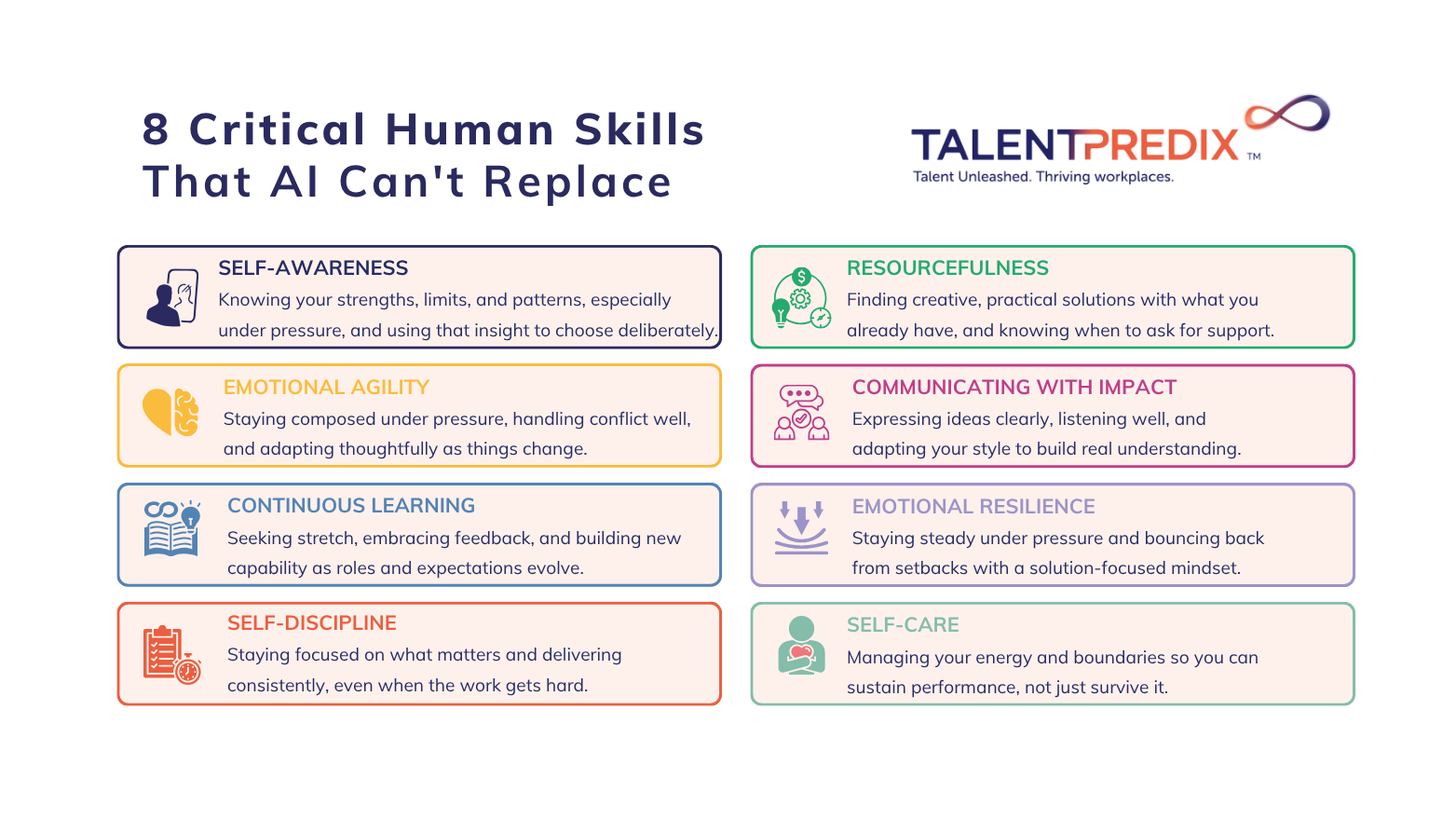
At TalentPredix™, self-discipline is one of the eight Self-Mastery skills, the Critical Human Skills people need to perform, adapt, and thrive in the Age of AI.

We define it as maintaining focus on priorities, managing distractions, and sustaining effort and quality when work becomes demanding. In practice, that means translating intentions into consistent action, even when motivation has run out.
A skill that only works when you feel like using it isn’t a skill. It’s a mood.
The most common mistake people make with self-discipline is treating low motivation as a problem to fix before they can act.
It doesn’t need fixing. It needs challenging.
Motivation is just a feeling, and feelings aren’t reliable guides to what matters. They shift with sleep, blood sugar, and how your last meeting went. Waiting for motivation to show up before you act is waiting for a coincidence, and procrastination is usually what fills that wait, dressed up as a plan.
“I’ll feel more like it tomorrow” is rarely true. It’s just easier to say than “I don’t want to do this right now.”
The gym floor at 6 a.m. is full of people who didn’t feel like it either. What’s different about them isn’t their feelings. It’s that they built a habit sturdy enough not to need their feelings’ permission.
That matters more than it sounds. We tend to assume some people are simply born disciplined and others aren’t, that it’s a fixed trait, like height. It isn’t. What actually separates them is mindset, habits, and self-efficacy: the belief that your own actions can produce the outcome you want.
Build that belief, alongside the right habit systems, and discipline stops being something you either have or don’t.
This is where self-discipline stops being a personality trait and starts being a mindset and habit-building opportunity, and there’s a growing body of research behind that shift.
Charles Duhigg’s The Power of Habit remains the clearest popular account of how this actually works, and its central idea, the habit loop, is worth applying directly to self-discipline at work.
Every habit, Duhigg argues, runs on three parts: a cue that triggers the behaviour, a routine that is the behaviour itself, and a reward that tells your brain the loop was worth repeating. Once that loop is established, the behaviour stops requiring conscious willpower. The brain hands it off to autopilot.
This reframes the whole problem. People assume disciplined colleagues are drawing on some deeper reserve of willpower than everyone else. Mostly, they’ve just built better, more consistent loops.
The person who reliably clears their inbox before lunch, or reliably prepares before a difficult conversation instead of winging it, isn’t fighting a daily battle of will. They’ve engineered a cue, a time, a location, or a preceding action, that fires the routine automatically, and a reward that closes the loop.
The discipline was in the design, not in the daily willpower spend.
The practical implication: if a behaviour at work keeps failing despite good intentions, the honest diagnosis is rarely “I need more willpower.” It’s usually “I haven’t built a loop.”
Fix the cue and the reward, and the routine gets a lot easier to sustain.
The other piece of research worth knowing changes how you should think about the early weeks of any new habit.
Most people have heard that habits take 21 days to form. However, that figure has no robust research behind it.
A more credible, peer-reviewed study led by Phillippa Lally at University College London tracked 96 people building a new daily behaviour over 12 weeks. The average time to reach automaticity was 66 days, and the range was 18 to 254 days, depending on the person and the behaviour.
Two things follow from that.
First, if a new discipline still feels effortful after three weeks, that is not failure. It is roughly on schedule. Most people quit in week two or three, at exactly the point the research says the behaviour is supposed to still feel hard.
Second, and just as usefully, Lally’s data also found that missing a single day here or there did not meaningfully derail the habit-formation curve.
Consistency matters more than perfection.
The gym-goer who skips a Tuesday and shows up Wednesday is still building the habit. The one who skips a Tuesday and decides the whole project has failed is the one who derails it.
Because self-discipline is closer to habit engineering than character, the development approach looks practical rather than inspirational.
Self-discipline isn’t only about pushing through the tasks in front of you. It’s equally about challenging the ones that shouldn’t be there in the first place.
Every “yes” to non-essential work undermines attention, energy, and focus, and the discipline to say “no” protects the same finite capacity and precious time you have.
Boundaries aren’t the opposite of discipline. They’re where it starts.
For individuals, the highest-leverage habit is reducing the friction between intention and action: lay the gym kit out the night before, block the calendar before the day fills up with other people’s priorities, and keep a simple decision checklist for the moments willpower is weakest.
Every extra decision in that moment is another chance to talk yourself out of it.
A second practice is attaching a reward that arrives immediately, not the distant one. “I’ll be healthier in six months” is a weak cue for showing up today. “Fifteen minutes to myself and a coffee afterward” works because the brain gets paid now, not eventually.
Managers build this in others less by giving advice on self-discipline and more by removing friction from the system: clear priorities instead of ever-changing ones, protected time instead of calendars assuming infinite availability, and recognition that lands close to the behaviour, not just at annual review.
Organizations build the capability structurally by making follow-through visible: checkpoints, shared trackers and scorecards, or simply a culture where “did we do what we said we’d do?” gets asked out loud and often.
Multi-rater feedback matters here too. Colleagues often spot a follow-through gap more accurately than the person does themselves, because the gap between intention and actual behaviour is exactly the blind spot self-perception struggles to surface.
For people with ADHD and other forms of neurodivergence, self-discipline can be genuinely harder to build, and that’s worth naming.
Starting tasks, holding a plan in mind, and resisting the pull of a more interesting distraction all draw on executive function, the brain’s system for inhibition, planning, and self-regulation. Russell Barkley’s research shows this is precisely where ADHD brains work differently.
Willpower was never built to compensate for that.
What tends to help instead is the same principle as the habit loop, just applied more deliberately: externalising the cue, using alarms and visible checklists instead of relying on memory, and shrinking the gap between routine and reward.
The goal isn’t more willpower. It’s building practical systems that empower the neurodivergent person and take the reliance off willpower altogether.
AI strips away a lot of the low-friction structure that used to carry us through mundane tasks.
Fewer fixed processes, fewer people checking in, more data and options on tap, and more autonomy over how and when work gets done. That sounds like freedom. For self-discipline, it’s a crucial stress test.
When the structure thins out and the cognitive load rises, your habit loops become the thing carrying you, because nobody else is going to notice a dropped ball as quickly as they used to.
The people who thrive in more autonomous, AI-augmented roles won’t be the ones with the most motivation.
They’ll be the ones whose follow-through doesn’t depend on it.
Good intentions are easy to overestimate. Follow-through is visible to other people.
TalentPredix™ Self-Mastery 360 combines strengths-based assessment with multi-rater feedback to help people see how Self-Discipline and the other Critical Human Skills show up in real working behaviour.
It gives individuals and organizations a clearer view of patterns around focus, consistency, priorities, and follow-through, creating a stronger foundation for practical development conversations.
Explore TalentPredix™ 360 to see how strengths-based feedback can support more focused, practical development for your people and leaders.
If you want to explore this topic further:
This is the sixth post in our Self-Mastery Series, where we break down each of the eight Critical Human Skills: what it means, why it matters, and how to build it deliberately.
Previous articles covered Resourcefulness, Self-Care, Continuous Learning, Emotional Agility, and Self-Awareness.
Next up: Communicating with Impact, and why saying the right thing isn’t the same as landing it.
Ask a room of professionals to list their weaknesses and the answers come immediately. Ask the same room to describe their strengths, the underlying qualities that energize them and produce their best work, and most people struggle. Ask how their colleagues would describe their strengths, and the room goes quiet.
I have run that exercise, in different forms, for two decades. The pattern never changes, and it tells us something important about how self-knowledge works in practice. People are trained from school onwards to catalogue their deficits. They receive far less specific information about what they do brilliantly, and almost no reliable information about how they land on other people.
The result is a workforce that feels self-aware and largely is not. Tasha Eurich’s research found that while 95% of people believe they’re self-aware, only 10–15% actually are, a huge gap between confidence and accuracy that sits underneath almost every other development challenge an organization has. Harvard Business Review
That gap matters because self-awareness at work is not simply about how accurately we describe ourselves. It shapes the quality of every development decision that follows.
At TalentPredix™, self-awareness is one of the eight Self-Mastery skills, the Critical Human Skills people need to perform, adapt, and thrive in the Age of AI. We define it as clarifying your Strengths, Motivations, Values, Limiters, and behavioural patterns, especially under pressure: owning mistakes, seeking feedback, and using insight to make deliberate choices that enhance effectiveness and impact. TalentPredix™ currently places Self-Awareness first within the eight-skill Self-Mastery framework. TalentPredix™
Self-awareness isn’t just one skill among eight for us. It’s also the opening stage of our 5-S Development Framework: Self-Awareness, Skill-Building, Support, Stretch, and Self-Mastery.
That placement isn’t decorative. Each stage that follows depends on accuracy at the first one:
Skip the first S, or get it wrong, and every stage after it inherits the error.
Notice, too, what sits inside that first box: feedback, self-reflection, and assessment. These are the same three inputs this article keeps returning to because none of them works alone.
Self-awareness is a discipline built from outside evidence, which is why it’s the one stage you cannot complete by yourself.
The standard prescription for self-awareness is introspection: reflect more, journal more, ask yourself why you do what you do.
The evidence complicates that advice. Eurich’s research found that people who introspect heavily are often no more self-aware than those who do not, and sometimes less. The problem is not reflection itself. It is the kind of questions we ask and the confidence we place in the stories our minds generate. Harvard Business Review
This is why self-awareness cannot be built through self-perception alone. Self-perception is one account, and a motivated one. Every account it gives is shaped by the same three needs: to feel safe, to feel competent, and to be liked. None of those needs has any particular interest in accuracy.
Reflection still matters, but its job is to process evidence, not replace it. Eurich’s work draws a useful distinction between asking “why” and asking “what”: what was I feeling, what triggered it, what will I do differently? “What” questions turn reflection towards observable patterns, while “why” questions can pull people further into explanation and rumination. Harvard Business Review
If self-awareness is the foundation everything else stands on, it’s worth asking what erodes it. Four blockers show up again and again, and none of them is solved by simply trying harder.
A leader intends to be decisive; the team experiences someone who cuts off discussion. A manager intends to hold high standards; a direct report experiences someone who is never satisfied.
In every case, the person’s self-assessment is built from their intention, while everyone else’s is built from their impact. Decades of self-other rating research, building on work by Atwater, Yammarino, and others, show that the gap between self-ratings and how others experience a leader is meaningful for understanding leadership effectiveness. ScienceDirect
The same mechanism shows up with overused strengths. Critical Thinking, taken too far, becomes someone who picks apart every proposal until colleagues stop bringing him ideas. Understanding Others, taken too far, becomes an inability to hold anyone accountable.
Both feel like strengths from the inside. Both can land as blockers from the outside.
The more power someone holds, the less accurate their self-assessment can become. Research discussed by Eurich found that higher-level leaders were more likely than lower-level leaders to overvalue their capabilities relative to how others saw them. The Last Eight Percent
Power doesn’t just insulate people from consequences. It can insulate them from accurate feedback.
Confidence can also rise faster than accuracy.
Eurich cites research showing that more-experienced managers were less accurate in judging their own leadership effectiveness than less-experienced managers. Years in a role can build certainty without necessarily building insight. The Sweeney Agency
The people best placed to correct the picture are often the least willing to.
Research on organizational silence has shown that employees’ decisions to speak up depend partly on whether they believe doing so will be effective and whether the personal cost feels safe. That can leave senior leaders with fewer honest signals precisely when they most need them. JSTOR
The practical implication holds across all four: the information you most need about yourself is, by definition, information you do not currently have. Someone else has it.
Self-awareness has always been the foundation skill, the one the other seven depend on. You cannot regulate an emotion you have not noticed, direct discipline towards the wrong priorities and call it focus, or choose the right development stretch without knowing your starting point.
The World Economic Forum’s Future of Jobs Report 2025 places motivation and self-awareness among employers’ top five core skills, alongside analytical thinking, resilience, flexibility and agility, and leadership and social influence. Foro Económico Mundial
The AI era sharpens the need in two specific ways.
First, careers are becoming less linear. When roles reshape every few years, the stable reference point can no longer be a job title or technical specialism. It has to be an accurate understanding of your Strengths, Motivations, Values, and Limiters. People with that clarity can navigate transitions more deliberately. People without it are more easily steered by circumstance.
Second, AI is a mirror-free environment, particularly in virtual or hybrid work. Machines do not push back, look bored, or bristle at your tone. As more of the working day is spent interacting with tools rather than people, some of the natural feedback that once corrected our self-perception, a colleague’s raised eyebrow or a meeting that suddenly goes cold, becomes easier to miss.
The feedback that remains has to be sought deliberately.
Some boundaries are worth drawing because this territory attracts comfortable substitutes.
It is not excessive introspection. As above, rumination can manufacture narrative rather than accuracy, and at its worst it curdles into unproductive self-focus.
It is not knowing your personality labels. A four-letter type or colour profile can start a conversation, but describing yourself in categories is not the same as understanding your behavioural patterns under pressure. Labels can actively obstruct growth when they become an excuse: “I’m just a red.”
It is not confidence, and it is not self-esteem. Confidence is a feeling about your ability; self-awareness is accuracy about it. Equally, harsh self-criticism is not self-awareness either. Under-estimators are inaccurate too, just in the humbler direction.
And it is not assuming intention equals impact. That assumption is precisely the thing the skill exists to correct.
Because much of the raw material is external, development here looks different from other skills. It is less about practice in private and more about creating honest feedback flows.
For individuals, the highest-value habit is specific feedback-seeking. Not “Have you got any feedback for me?”, a question that reliably produces “No, all good”, but precise requests tied to real events:
“In that meeting, what did I do that helped, and what got in the way?”
A second practice comes from our coaching workbook. Ask two people, one at work and one outside it:
“What is one thing I do that I am unaware of, but that affects how others experience me?”
The overlap between their answers is usually the finding.
Behavioural evidence beats impressions. A short record of situations where you were at your best and worst, and the conditions they share, generates pattern data introspection cannot.
Managers and leaders build others’ self-awareness mostly through the quality of their feedback: specific, behavioural, and balanced between strengths and growth areas.
The imbalance matters more than most managers realize. As noted earlier, most people already have a lifetime’s supply of deficit information. What they lack is precise information about their strengths and the impact of those strengths on others.
A development conversation that only ever asks “What could you improve?” is reinforcing the blind spot, not correcting it.
Organizations create the conditions through psychological safety and structured feedback mechanisms that reach people before problems calcify.
This is where multi-rater feedback is particularly valuable: it gives people systematic evidence about the gap between how they see themselves and how others experience them.
This is the role the TalentPredix™ 360 Self-Mastery Profile is designed to play.
It combines self-ratings with observer feedback across all eight Self-Mastery skills, alongside the person’s Strengths, Motivations, Values, and Limiters, so the conversation can move from “how I see myself” to “how my intentions compare with my impact”, with evidence on the table rather than assertion. TalentPredix™ 360 currently combines its strengths assessment with multi-rater feedback and includes Self-Awareness within the Self-Mastery version. TalentPredix™
Two patterns from debriefs are worth naming.
Where self-ratings run well above observer ratings, the person is usually not deluded. More often, they are rating their intentions while observers rate their behaviour.
And where observer ratings run above self-ratings, the finding is often a hidden strength: something the person does well, discounts, and could deploy far more deliberately if they believed the data.
Both conversations change what a person does next, which is the test of any development insight.
Self-awareness is the foundation the rest of this series builds on, and the first S in how we structure development at TalentPredix™.
It is also a skill people routinely overestimate in themselves, which makes guessing a poor basis for development.
If your development conversations rely mainly on self-assessment, start by adding another source of evidence.
TalentPredix™ 360 combines strengths-based assessment with multi-rater feedback to help people understand both how they see themselves and how others experience their strengths, behaviours, and impact. The result is a stronger foundation for focused, practical development conversations.
Explore TalentPredix™ 360 to see how strengths-based feedback can support more accurate self-awareness and development across your people and leaders. TalentPredix™
If you want to explore this topic further:
The previous four articles are all now live, including Emotional Agility, which was published on 11 August 2026. TalentPredix™
This is the fifth post in our Self-Mastery Series, where we break down each of the eight Critical Human Skills: what it means, why it matters, and how to build it deliberately.
Next up: Self-Discipline, and the widening gap between knowing what matters and consistently doing it.
A restructure is announced on a Monday. By Wednesday, a normally solid manager is snapping at questions in the weekly team meeting and has stopped replying to two peers he feels “should have warned him.”
He has quietly started polishing his CV instead of drafting the transition plan his director asked for. Nobody would call him unprofessional. He shows up, he delivers, and he says the right things in the town hall. But underneath the composure, he is reacting to every fresh piece of information as a threat, and his team can feel it.
Three weeks later, the change stalls in his part of the business, not because the plan was wrong, but because he never processed his own reaction to it enough to lead anyone else through theirs.
That manager doesn’t have a skills gap. He has an emotional agility gap, and it is one of the most common and least diagnosed reasons change initiatives fail.
Emotional agility at work is what allows people to experience the reaction without letting it dictate what they do next.
Gartner’s research found that employee willingness to support organizational change fell from 74% in 2016 to 43% by 2022. Over the same period, the number of planned enterprise changes the average employee experienced in a year rose from two to ten. Harvard Business Review reported these Gartner findings in 2023. Harvard Business Review
Most organizations read numbers like these and diagnose a change management problem. Better communications. Clearer roadmaps. More meetings.
I read them differently. What those numbers describe is an emotional capacity problem. People are not confused about what is changing. They are tired, apprehensive, and in many cases quietly angry about it, and most workplaces give them nowhere useful to take those feelings.
So the feelings go underground and resurface as resistance, cynicism, and disengagement.
The skill that determines whether people can move through change without being driven by their emotional reaction to it has a name: emotional agility. At TalentPredix™, it is one of the eight Self-Mastery skills, the Critical Human Skills people need to perform, adapt, and thrive in the Age of AI. TalentPredix™
We define it simply: regulating emotions to remain composed and responsive under pressure, handling conflict constructively, staying open to diverse perspectives, and adapting behaviour thoughtfully in uncertain or changing situations.
The key word is responsive. Not calm. Not controlled. Responsive.
Here is the distinction that makes emotional agility worth understanding properly.
Every difficult moment at work, a restructure announcement, a criticism in front of colleagues, a project cancelled after months of effort, produces an emotional reaction. That reaction is not optional. It arrives before conscious thought, and no amount of professionalism prevents it.
What is optional is what happens next. Between the emotional experience and the behavioural response there is a space, and emotional agility is the skill of using it well.
Psychologist Susan David’s research, which gave the concept its name, describes the alternative as getting “hooked”: treating a passing thought or feeling as a fact and acting from inside it. The manager who feels threatened by a restructure and starts quietly briefing against it. The leader who receives challenging feedback and spends the meeting defending rather than listening. Neither would describe themselves as emotional. Both are being steered by emotion they have not acknowledged. Harvard Business Review
David’s work points to a sequence agile responders use instead: notice the emotion, name it accurately, accept that it is there, then choose a response aligned with your values rather than your impulse.
It sounds simple. Under real pressure, it is one of the hardest disciplines in professional life.
Emotional intelligence (EQ) has earned its place in the conversation.
The World Economic Forum’s Future of Jobs Report 2025 lists empathy and active listening among the core skills employers expect workers to need, alongside capabilities including resilience, flexibility, agility, and continuous learning. World Economic Forum
Pearson’s Skills Outlook, built from an analysis of more than 21 million job ads across the US, UK, Canada, and Australia, found that the “power skills” employers are hiring for are overwhelmingly human ones, including collaboration, communication, leadership, and cultural and social intelligence. Pearson plc
So the evidence isn’t in question. My problem is with the meaning the term conveys and what it asks people to actually develop.
Start with the word “intelligence”. To many, it implies something fixed and cerebral, and whether EQ is really a form of intelligence at all is still disputed among psychologists. But set that debate aside.
In practice, most people use “emotional intelligence” to mean something narrower: noticing emotions accurately, yours and everyone else’s in the room.
Emotional agility is what happens after the noticing.
Not “can you name the emotion?” but “can you act well while it’s live?” That’s narrower, more coachable, and far easier to observe in someone’s actual behaviour, which is why it belongs in a skills framework, not left as a trait some leaders are assumed to have and others aren’t.
It’s also the more honest name for what breaks under pressure. Almost none of the leaders I coach through failed change programmes were unaware their team was anxious. They knew.
What they lacked was the trained ability to stay open, curious, and values-led while standing inside that anxiety themselves.
That’s agility. Not intelligence. And it’s what we assess and build in the Self-Mastery framework.
AI transformation is frequently treated as a technology programme with a training plan attached. In practice, it is one of the most emotionally loaded changes most workforces have experienced.
It touches identity: people who have built self-worth on expertise watch parts of that expertise become automatable.
It touches security: few leaders can honestly promise that every role is safe.
And it moves fast enough that the normal human process of adjusting to change never quite completes before the next change arrives.
In that environment, unprocessed emotion becomes an organizational force. Gartner’s research links change fatigue to eroded intent to stay and measurably reduced performance. Gartner
The World Economic Forum’s Future of Jobs Report 2025 ranks resilience, flexibility, and agility among the most important core skills identified by employers. World Economic Forum
Leaders with emotional agility do something distinctive here: they treat resistance as information rather than insubordination.
When a team pushes back on an AI rollout, the agile response is not to repeat the business case more loudly. It is to get curious about what the resistance is protecting, competence, fairness, identity, workload, and address that directly.
You cannot do this for others until you can first do it for yourself.
The manager in our opening example never got there. His team didn’t need more explanation of the restructure. They needed him to be steady enough to hear what they were actually worried about.
Emotional agility rarely announces itself. It shows up in small, observable behaviours:
Notice that none of these behaviours is emotionless.
In each case, the emotion is present, acknowledged, and working for the person rather than against them.
Like all Self-Mastery skills, emotional agility is not a fixed trait. It develops through practice, and the practice is specific.
For individuals, the foundational habit is accurate labelling. Research consistently shows that naming an emotion precisely, “I’m feeling defensive because that comment questioned my judgement” rather than “I’m stressed”, reduces its grip and restores access to deliberate thinking. Research on affect labelling has found reduced emotional reactivity when feelings are put into words. PubMed
A second habit is the neutral-observer reframe: taking a triggering situation and describing it as a fair-minded outsider would.
In our coaching work, we ask people to write both versions down. The gap between the two accounts is usually where the insight lives.
Managers and leaders shape the conditions more than they realize. Gartner’s research found that when managers create a psychologically safe team environment, change fatigue can fall by up to 46%. Gartner
Practically, this means:
Organizations build the skill structurally when they stop treating emotion as noise in the system.
Decision debriefs that ask “what was driving our thinking?” build collective agility. So does giving change programmes an explicit listening mechanism, so emotional response data reaches decision-makers while it can still shape the plan.
One connection worth making: emotional agility draws heavily on energy. A depleted person has a shorter fuse and a smaller space between feeling and response, one reason the self-care practices we covered earlier in this series are not a separate topic.
Regulation is expensive, and it is paid for in recovery.
There is a difference between a team that avoids conflict and a team that processes it.
| Reactive culture | Emotionally agile culture |
|---|---|
| Difficult feelings are managed privately, off to the side | Difficult feelings are named openly, as part of the work |
| Composure is mistaken for alignment | Behaviour under pressure is treated as the real signal |
| Resistance is read as a people problem | Resistance is read as project intelligence |
| Feedback is softened until it says nothing | Feedback is direct, and the reaction to it is coached |
| Change communication stops at “here’s what’s happening” | Change communication includes “here’s what this might bring up” |
This distinction matters because many organizations invest heavily in change communication, yet still watch adoption stall.
The issue is rarely a lack of information. It is usually a lack of somewhere for the emotional reaction to go.
There is a measurement problem with this skill: almost nobody experiences themselves as reactive.
We judge ourselves by our intentions and our inner narrative, while colleagues experience our tone, our timing, and our behaviour under pressure.
This is why multi-rater feedback is so valuable here.
In the TalentPredix™ 360 Self-Mastery Profile, emotional agility is assessed through both self-rating and observer feedback, alongside the other seven Critical Human Skills and the person’s Strengths, Motivations, and Values. TalentPredix™ currently positions Self-Mastery specifically for deeper development and adaptation through change. TalentPredix™
The most productive development conversations often start from the gap: a leader who rates themselves composed and open, whose colleagues report walking on eggshells before delivering difficult news.
That gap is not an accusation.
It is a starting point, and in our experience, one of the fastest routes to genuine behavioural change, because it replaces argument about intentions with evidence about impact.
You can measure whether change lands. But do you know whether your people have the emotional capacity to carry it?
TalentPredix™ Self-Mastery 360 combines strengths-based assessment with multi-rater feedback to help people see how Emotional Agility and the other Critical Human Skills show up in real working behaviour, not just in their own self-perception.
It gives individuals and organizations a clearer view of the gap between intention and impact, creating a stronger foundation for development conversations around adaptability, resilience, self-awareness, and performance under pressure.
Explore TalentPredix™ 360 to see how strengths-based feedback can support more focused, practical development for your people and leaders.
If you want to explore this topic further:
This is the fourth post in our Self-Mastery Series, where we break down each of the eight Critical Human Skills: what it means, why it matters, and how to build it deliberately.
Next up: Self-Awareness, and why it cannot be built through self-perception alone.
Here’s an uncomfortable truth for every person reading this: a growing share of the skills that got you where you are today will not get you where you are going.
The World Economic Forum estimates that around two-fifths of workers’ core skills will change by 2030. The obsolescence rate of many technical skills is now measured in a handful of years, and that window is shrinking fast.
In a world moving this quickly, what you know still matters. But it matters less than how quickly you can learn what comes next.
Most organizations are responding to this by building more detailed skills inventories: taxonomies, frameworks, dashboards, and capability maps. These are useful, but they are incomplete.
A skills inventory tells you what people know today. It tells you far less about the one variable that determines whether that inventory will still be accurate in two years: how fast your people can learn, unlearn, and adapt.
That is why, at TalentPredix™, continuous learning is one of the eight Self-Mastery skills: the critical human skills people need to understand, assess, and develop to perform, adapt, and thrive in the Age of AI.
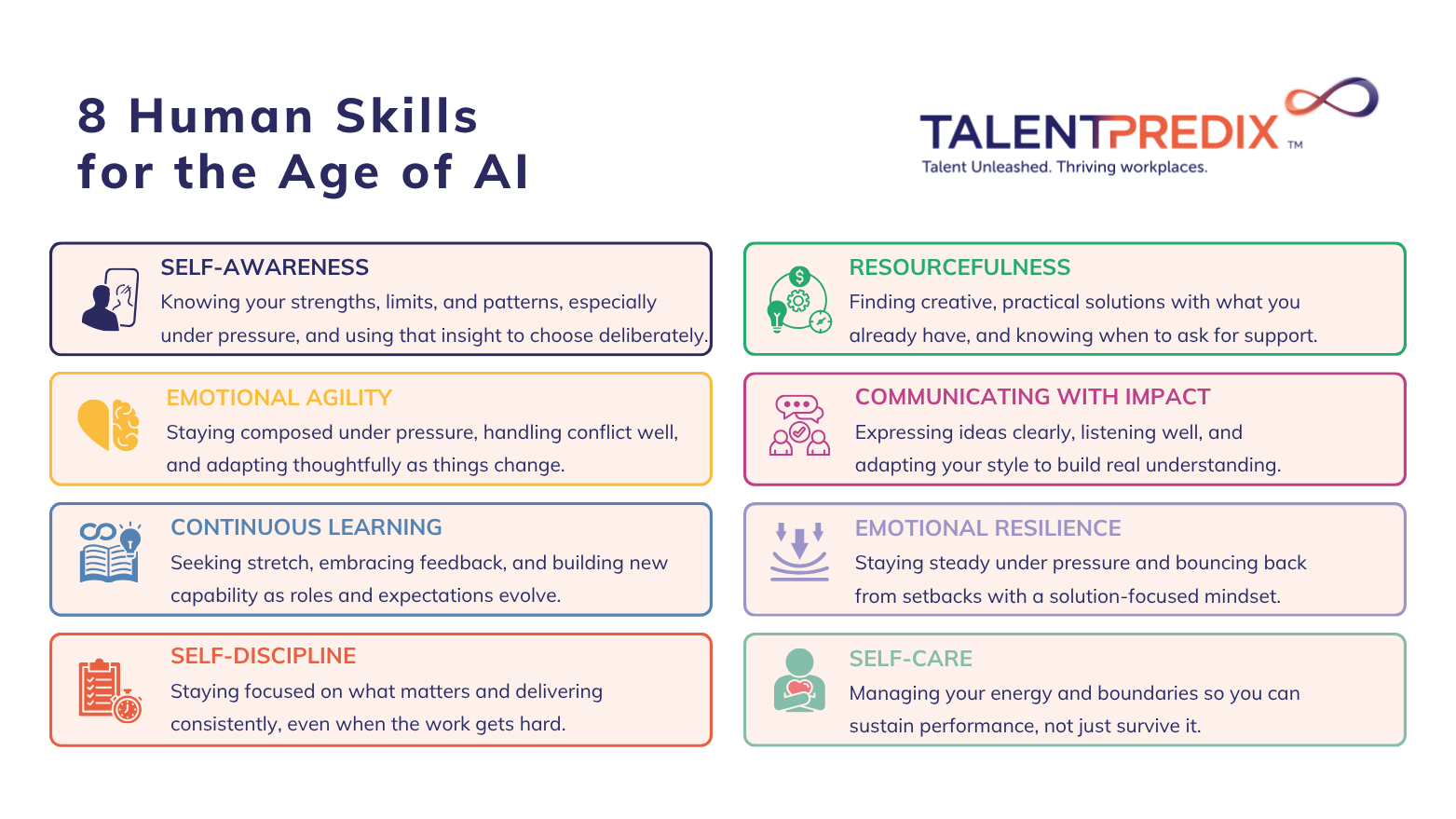
We define continuous learning simply: continuously seeking to learn, improve, and embrace opportunities for personal and professional development.
Not courses for the sake of courses. Not compliance training. Not another well-meaning learning platform that people open twice and forget. The real skill is the deliberate habit of stretching beyond what you already know and treating every challenge, setback, and unfamiliar situation as an opportunity for growth.

For years, learning was treated as something separate from work.
You did your job. Then, occasionally, you attended training. Maybe you completed an online module. Maybe you had a development conversation once a year, usually squeezed into a performance review that was already trying to do too much.
That model no longer works.
Roles are changing too quickly. AI is reshaping tasks, expectations, and workflows. Skills that looked valuable a few years ago are becoming easier to automate, while other skills are rising in importance almost overnight.
The question for HR, L&D, and talent leaders is no longer just: what skills do our people have?
It is: how quickly can our people learn what comes next?
That is learning capacity. And it is becoming one of the most important predictors of whether individuals, teams, and organizations can stay relevant through change.
Skills data matters. It helps organizations understand current capability, workforce gaps, internal mobility opportunities, and development priorities.
But on its own, it can become dangerously static.
| A skills inventory shows… | Learning capacity shows… |
|---|---|
| What people know today | How quickly people can learn tomorrow |
| Current technical capability | Adaptability under changing conditions |
| Role fit now | Growth potential over time |
| Existing skills gaps | Ability to close those gaps |
| What may need training | Who is most ready to stretch, unlearn, and improve |
A person may have the right skills today, but little appetite to adapt tomorrow. Another person may not yet have the full skill set, but may show strong curiosity, feedback-seeking, experimentation, and adaptability.
In a fast-changing environment, that second person may be the better long-term bet.
The most resilient talent strategies will not only identify current capability. They will identify the people most likely to grow into what comes next.
That is why talent development needs to move beyond static skills mapping and start asking sharper questions about learning agility, motivation, and adaptability.
Continuous learning is the skill that underpins and renews all the others.
Every other skill has a shelf life. Technical knowledge expires. Tools change. Best practice moves. Even leadership expectations evolve as the world of work changes around us.
Continuous learning is what keeps people current.
The research base here is deep. Carol Dweck’s work on growth mindset shows that people who believe capability can be developed are more likely to persist through challenge, seek feedback, and treat setbacks as part of learning.
The retention evidence is also hard to ignore. LinkedIn’s Workplace Learning Report consistently highlights learning and career growth as major factors in whether people stay with an organization or look elsewhere.
That matters because development is no longer just a benefit. For many people, it is part of the psychological contract.
If people feel they are growing, they are more likely to stay engaged, adaptable, and future-focused. If they feel their growth has stalled, they start looking for movement elsewhere.
As I argued in Resourcefulness: The Under-the-Radar Super Skill of the AI Age, uncertainty rarely arrives as one dramatic event. It usually shows up as a steady stream of new tools, shifting priorities, unclear problems, and unfamiliar expectations.
Continuous learners do not wait for the training calendar to catch up. They close the gap themselves.
AI has not just made learning more important. It has made it non-negotiable.
Every wave of AI capability redraws the boundary between what machines can do and what humans add. The people who thrive will not simply be those with the most accumulated knowledge. AI has commoditized access to information.
What it has not commoditized is the appetite and agility to keep acquiring, testing, and applying new insight.
That is where continuous learning becomes a serious performance skill. It shows up when someone learns a new tool before they are formally trained on it, unlearns an outdated process without ego, asks better questions than the technology can answer, or moves from “this is how we have always done it” to “what is now possible?”
This is also where continuous learning connects to energy and sustainability.
As I explored in Self-Care: The Human Skill We’ll All Need to Invest in to Thrive in the AI Era, growth depends on capacity as much as ambition. People cannot keep learning if they are depleted, distracted, or running on empty.
Learning is a renewable resource, but only if people protect the energy required to do it.
Continuous learning is not always dramatic. Often, it looks like small, repeated behaviours that compound over time.
It is the manager who asks for feedback after a difficult conversation. The employee who experiments with a new AI tool before being formally trained. The leader who admits an old approach is no longer working. The team that reviews what it learned from a failed project instead of rushing past it.
These behaviours matter because they change how people respond to uncertainty.
Instead of waiting for certainty, continuous learners create movement. Instead of protecting their existing expertise, they expand it. Instead of seeing change as a threat to competence, they treat it as an invitation to build new capability.
That is the difference between a workforce that is trained and a workforce that is adaptive.
Like all Self-Mastery skills, continuous learning is not fixed. It can be built through deliberate practice.
For individuals, that means developing habits such as:
That final point matters. Learning that depends on spare time rarely happens.
If learning is strategically important, it needs space, structure, and permission. Otherwise, it gets crushed by delivery pressure.
Organizations need to play their part too. The best create cultures where curiosity and experimentation are rewarded, questions are safe, and development conversations happen continuously, not only once a year.
That means managers need the insight, confidence, and language to support learning in the flow of work. Not vague encouragement. Not “keep developing yourself”. Specific, strengths-based conversations about what someone is ready to build next.
This is where strengths assessment, coaching, and feedback can play a powerful role. When people understand their Strengths, Motivations, Values, and Limiters, they can make better choices about where to grow, how to stretch, and what conditions will help them sustain progress.
There is a difference between offering training and building a learning culture.
One is an activity. The other is a capability.
| Training culture | Learning culture |
|---|---|
| Learning happens in formal sessions | Learning happens in the flow of work |
| Development is owned by HR or L&D | Development is shared by leaders, managers, and individuals |
| People wait for courses | People seek feedback, stretch, and experiment |
| Failure is quietly avoided | Failure is treated as useful data |
| Progress is measured by completion | Progress is measured by behaviour change |
This distinction matters because many organizations are investing heavily in learning infrastructure, but still struggling to build real adaptability.
The issue is not always a lack of content. Often, it is a lack of learning behaviour.
Continuous learning is the bridge between development strategy and actual behaviour change.
You measure skills. But are you measuring learning capacity?
A skills inventory can show what your people know today. It cannot tell you whether they are ready to adapt tomorrow.
TalentPredix™ 360 helps organizations assess and develop the critical human skills that keep people performing, adapting, and growing in the Age of AI, including Continuous Learning.
It combines strengths-based assessment with 360-degree feedback, giving individuals and organizations a clearer view of how Strengths, Motivations, Values, and Self-Mastery skills show up in real working behaviour.
For HR, L&D, and talent leaders, this creates a stronger foundation for development conversations, coaching, leadership growth, internal mobility, and future-ready workforce planning.
If your organization is serious about building adaptability, start by measuring the human skills that make adaptation possible.
Request a free TalentPredix™ trial to see how Continuous Learning and the other Self-Mastery skills show up in practice.
If you want to explore this topic further, these resources are a useful next step:
This is the third post in our Self-Mastery Series. Each week, we are breaking down one of the eight critical human skills: what it means, why it matters, and how to build it deliberately.
After more than 30 years coaching leaders and talented people across some of the world’s most successful organizations, one pattern stands out above almost all others:
The more driven people are, the harder they find it to stop – and the higher the potential risks to their health, relationships and long-term performance.
Not because they lack self-awareness, but because the drive that got them there doesn’t come with an off switch – it becomes obsessive.
At TalentPredix™, self-care is one of the eight Self-Mastery skills – the critical human skills that help people perform, adapt, and thrive in the Age of AI.
Self-care. Not spa days. Not work-life balance slogans on a poster.
The real, deliberate practice of managing your energy, protecting your recovery, and taking responsibility for the physical, mental, and emotional foundations that determine how well you perform, think, and lead.
For a long time, neglecting self-care was quietly rewarded:
In many organizations, depletion was disguised as dedication.
High-achievers are often the ones to neglect self-care most. Their drive and need for achievement can become all-consuming – and they are frequently the last to recognize the cost.
We spend roughly 80,000 hours at work across a career: more waking time in the office than at home, over 40 to 50 years. It is hardly surprising that many people’s identities become so fused with their work that they feel anxious about disconnecting.
Mobile devices encourage an always-on mindset when boundaries are not actively maintained, and poor habits creep in gradually – distance from family and loved ones, and the quiet erosion of mental and physical health that follows.
“Depletion was disguised as dedication. That era is over – because the data is now too loud to ignore.”
The McKinsey Health Institute estimates that structuring workplaces to support holistic health could unlock up to US$1.7 trillion in global productive value.
Burnout – the direct, predictable consequence of sustained self-care failure – reduces creativity, increases errors and turnover, and is associated with elevated rates of depression and cardiovascular disease.
It is not a personal failing. It is a preventable organizational risk.
It is worth remembering that work-life balance is deeply subjective.
| Some people need… | Others need… |
|---|---|
| Firm boundaries to function at their best | Flexibility to work when they feel most energized |
| Clear disconnection from work | More fluid patterns across evenings or weekends |
| Recovery built into the working day | Freedom to manage energy in their own way |
Some people are genuinely energized by working evenings and weekends; others need firm boundaries to function at their best. Neither is inherently wrong.
The goal is not to impose a single model, but to help people avoid the obsessive, all-consuming patterns that quietly undermine wellbeing – the ones that lead to burnout and, in the worst cases, to chronic health conditions that shorten both careers and lives.
AI transformation is accelerating the pace of change, expanding cognitive load, and blurring the boundaries between work and everything else.
PwC’s 2025 Global Workforce Survey found that workers experiencing chronic fatigue, anger, or overwhelm are 30% less motivated. Only 33% of employees globally are currently thriving (Gallup, 2025).
These are the baseline conditions in which most organizations are asking people to adapt, upskill, and perform.
“AI doesn’t fix depletion. In many cases, it amplifies it – raising the cognitive load, compressing decision cycles, and removing the recovery buffers people didn’t even realize they were relying on.”
Like all Self-Mastery skills, self-care at work is not a fixed trait. It can be built through deliberate practice.
Wellhub’s 2026 research across 5,000+ employees found that 89% perform better when they prioritize health through structured wellness practices.
The word ‘structured’ matters: ad hoc good intentions do not sustain under pressure. Systems do.
Practically, this means:
“Self-care is not separate from leadership effectiveness. It is an integral part of it – the resource from which everything else is drawn.”
Self-care is central to the Self-Mastery framework, not an afterthought.
| Without self-care… | The risk is… |
|---|---|
| Self-discipline without recovery | Depletion |
| Emotional resilience without restoration | Brittleness |
| High performance without sustainability | Burnout |
The eight skills are a system, and self-care is what keeps that system running.
The question is not whether your people are performing.
It’s whether the conditions exist for them to keep performing and thriving – not just this quarter, but throughout their career.
Self-care is one of eight Self-Mastery skills measured in the TalentPredix™ 360 Self-Mastery Profile, alongside strengths, feedback, and the critical human skills people need to perform, adapt, and thrive in the Age of AI.
If you want to understand how self-care, resilience, emotional agility, resourcefulness, and the other Self-Mastery skills show up across your organization, request a free TalentPredix™ trial.
You’ll see how the profile works, what it reveals, and how it can support more focused development conversations for your people, leaders, and teams.
This is the second post in our Self-Mastery Series. Each week, we’re breaking down one of the eight skills, what it means, why it matters, and how to build it deliberately.
Resourcefulness at work is becoming one of the most important human skills in the Age of AI.
Resilience gets all the headlines. It’s the word HR and leaders reach for when they talk about navigating uncertainty, change, and pressure.
However, there’s a quieter capability working alongside it – one that rarely gets the spotlight, despite being just as important: resourcefulness.
At TalentPredix™, we define resourcefulness as one of the eight Self-Mastery skills – the critical human skills that allow people to perform, adapt, and thrive in the Age of AI. Specifically, it’s about identifying creative, practical solutions using the knowledge, tools, and networks already available to you. It’s adapting quickly to new situations, asking insightful questions, and leveraging support to overcome obstacles effectively.
In other words, resourcefulness is what turns “we don’t have what we need” into “here’s what we can do with what we’ve got.”
Resilience helps us absorb shocks and bounce back. Resourcefulness helps us find a way through in the first place.
The two are deeply connected – research on organizational resilience increasingly frames resourcefulness as a core behavioural dimension of resilience itself, alongside agility in unexpected situations and the ability to adapt routines and reallocate resources when conditions shift. Research from Gallup also highlights the importance of helping people use their strengths effectively to improve performance and adaptability.
This matters because uncertainty rarely arrives as a single dramatic event. More often, it shows up as a steady stream of smaller ambiguities – shifting priorities, incomplete information, new tools, unclear instructions. Resourcefulness is the skill that keeps people moving productively through all of that noise, rather than waiting for clarity that may never fully arrive.
There’s also a strong theoretical basis for why resourcefulness fuels motivation under pressure. Conservation of Resources theory, one of the most influential frameworks in organizational psychology, holds that people are fundamentally motivated to protect and build up the resources – strengths, skills, knowledge, relationships, tools – that help them cope with stress and pursue goals. Resourcefulness is essentially this theory in action: it’s the active, deliberate process of mobilising, combining and strengthening resources, rather than passively waiting for the right conditions to appear. When people feel capable of generating options for themselves, motivation tends to follow.
As AI takes over more routine, information-processing tasks, the value of resourcefulness only grows.
AI can generate options, summarise information, and surface possibilities at speed – but someone still has to decide which option fits the situation, ask the right follow-up question, or combine an AI output with a piece of tacit knowledge that only a human would think to apply.
That’s resourcefulness at work: using all available tools and resources, including AI itself, creatively and practically to solve real problems.
Like all Self-Mastery skills, resourcefulness isn’t fixed.
Developing resourcefulness at work requires more than resilience training alone.
It can be developed through deliberate practice: rotating people through unfamiliar challenges and stretch opportunities, encouraging them to ask “what do we already have that could help here?”, and creating environments where experimentation and creative problem-solving are genuinely encouraged and safe.
Organizations that develop resourcefulness alongside resilience build something powerful – people who don’t just survive uncertainty, but actively find their way through it. Organizations that strengthen resourcefulness at work create people who can adapt, solve problems, and thrive through uncertainty. In a world where change is constant and answers are rarely handed to us, that might be the most powerful human skill of all.
Resourcefulness is one of eight Self-Mastery skills measured in the TalentPredix™ 360, the only assessment that reveals Strengths, Motivations, Values, and Critical Human Skills together.
See how resourcefulness and the other seven Self-Mastery skills show up across your organization. Request a free trial or view a sample profile to see it in action.
This is the first post in our Self-Mastery Series. Each week, we’re breaking down one of the eight skills, what it means, why it matters, and how to build it deliberately. Next up: Emotional Agility.
James Brook | TalentPredix™ | April 2026
AI can write your session notes. It can track your client’s goals, spot patterns across conversations, and generate a development plan before you’ve had your first coffee. It’s fast, tireless, and getting better every month.
So here’s the uncomfortable question: if AI can do all of that, what exactly are you for?
I’ve been sitting with this question for a while. And I think most of us in the coaching profession are answering it the wrong way. We’re pointing at AI’s limitations – “it can’t feel, it can’t truly listen, it can’t build real trust” – and using them as reassurance. ‘See? We’re still needed.’
That’s the wrong conversation.
The right conversation is this: are you actually delivering what only a human can deliver? Because the research is unambiguous on what that looks like – and it’s a high bar.
In controlled trials, AI-generated responses are sometimes rated as more empathic than those written by humans. And yet when people know they’re talking to a machine, they consistently report feeling less understood – even when the words are identical. The neuroscience is clear: human connection activates something biological. Mirror neurons, oxytocin, dopamine. These aren’t metaphors. They’re mechanisms. No algorithm touches them.
Bill Campbell – the Trillion Dollar Coach – didn’t build his reputation on technique. His colleagues described his method simply as love. Unconditional care for the person in front of him. That’s what made radical honesty feel safe rather than threatening. You either have that or you don’t. Clients – especially senior ones – know the difference.
Most of the problems clients bring us aren’t well-defined. They’re contradictory, ambiguous, loaded with competing pressures – and the client often can’t see clearly because they’re standing inside the problem. A skilled coach doesn’t hand them a framework. They sit alongside them in the mess, helping them slow down, surface what they’re actually assuming, question beliefs they’ve never examined, and weigh choices against what they genuinely value – not what looks good on paper.
That process is inherently human. It requires curiosity without agenda, the ability to hold contradictions without rushing them to resolution, and the moral seriousness to engage with the ethical dimensions of a decision rather than optimise around them. AI can generate options. It can map scenarios. What it cannot do is help someone discover that the reason they keep avoiding a particular choice is rooted in a belief about themselves they’ve never said out loud.
That’s the work. And it only happens in the presence of another human being who is paying full attention.
It can send you a reminder. It cannot make you feel the mild discomfort of knowing that someone who genuinely cares about your growth is going to ask you about it. That discomfort is not a flaw in the coaching relationship. It’s the mechanism.
Marshall Goldsmith’s feedforward discipline is worth stealing here. End every session with one precise, forward-facing question – What will you do specifically and differently this week? – then go completely silent. Most coaches fill that silence. The silence is the work.
The warmth of a coaching relationship can quietly become a comfort zone – for the client, and for the coach. If you’re avoiding a difficult conversation to preserve the connection, you’re not serving your client. You’re serving yourself.
The rise of AI isn’t just a challenge to our profession. It’s an invitation to honest self-examination. The bar is rising. The coaches who will thrive aren’t those who point at what AI can’t do. They’re the ones ruthlessly honest about what they themselves are – and aren’t – bringing.
That’s a harder question. But it’s the right one.
I’ve written a full guidance document on this – covering the five things AI cannot coach, the self-mastery framework every coach needs, and the lessons from Goldsmith and Campbell that most CPD programmes won’t give you.
To request a copy, contact us at info@talentpredix.com or speak to us about TalentPredix™ Practitioner Certification.
Explore Practitioner Certification
Request a Free Trial
You last had a proper career conversation with one of your team… when exactly?
If you’re struggling to remember, you’re not alone — and you’re not the problem. You’re a manager juggling a dozen competing priorities, and career development is the thing that always gets bumped. It feels important. It never feels urgent. And so it waits.
But here’s what’s waiting alongside it: your best people, quietly updating their CV.
Only 15% of employees have regular career growth conversations with their manager.
Read that again. 15%.
A separate survey found that 53% of employees want more career conversations with their manager — but say their managers are simply too busy to have them. (CFO.com)
And the cost of this gap? It’s huge!
93% of employees say they are more likely to stay with an organization that invests in their career development. (Thirst) Meanwhile, 74% of Millennial and Gen Z employees say they would leave if not given enough opportunities for skills development. (Inspirus) In exit interviews across more than 20,000 cases, lack of career growth remains one of the leading drivers of turnover. (HiBob)
Career and growth opportunities are not a “nice to have”. They are arguably the single most important factor in attracting, retaining and getting the very best from people.
Here’s the uncomfortable truth: even with the best intentions, most managers are not equipped to lead career development conversations — and it’s not their fault.
Nearly half of all employees say their manager doesn’t know how to help them with career development. Research by Right Management found that two-thirds of managers are failing to support their employees’ career growth. (ManpowerGroup)
Before the AI era, managers were already overwhelmed. Many are simultaneously individual contributors and people managers, constantly pulled between tactical delivery and long-term development — and it is always the former that wins, because that is what gets measured and rewarded. Career planning becomes, at best, a nice-to-have.
Now add AI transformation reshaping roles, workflows and skill requirements almost overnight. Managers have even less bandwidth. Expecting them to function as skilled career coaches — even with training — is no longer realistic. It was perhaps always an unrealistic ask.
“Just as elite athletes need specialist coaches, not just their team manager, employees deserve dedicated career experts — not an overwhelmed line manager squeezing in five minutes between meetings.”
— James Brook, Founder, TalentPredix™
Think about how elite sport works.
A Premier League footballer doesn’t rely on their head coach for nutrition advice, mental resilience training, biomechanics analysis and contract strategy. They have specialist coaches for each. The head coach focuses on what they do best: performance on the pitch, team dynamics, game-day decisions.
Why do we expect anything different in organizations?
The manager’s role is not to be all things. It is to coach for day-to-day performance: offering feedback, encouragement, support and accountability. Career development — the deeper work of exploring options, mapping strengths, building individual development plans, navigating internal mobility — requires a different kind of specialist.
When we free managers from the pressure of being career coaches, we let them play to their own strengths. Everyone wins.
A senior manager — talented, committed, genuinely invested in her team — told us recently that she hadn’t had a proper career conversation with any of her direct reports in over six months. Not because she didn’t care. Because every week, something more urgent won.
Three months later, one of her highest-potential team members resigned. In the exit interview, the reason was simple: “I didn’t feel like anyone was invested in where I was going.”
That manager was devastated. She had assumed good intentions were enough. They weren’t. And she had never been given the tools, the time, or the specialist support to do this well.
In my experience, this is not an isolated story. It is the norm.
Organizations that get this right are not necessarily spending more. They are spending smarter — engaging specialist career coaches and business psychologist to deliver tailored, scalable career development services alongside line management.
This can include one-to-one career coaching, strengths and skills mapping, structured career development workshops, and support with internal mobility conversations. Done well, these services generate something else of enormous value: rich, aggregated, anonymised insight into employee engagement and career progress — insight that is far more dynamic and useful than an annual ‘tick box’ engagement survey.
The business case is not complicated. Career development is a lever for performance, retention and organizational resilience. The organizations that invest in it don’t just keep their best people longer — they build the kind of culture that attracts great people in the first place.
The question is no longer whether to invest in career development. It’s who is best placed to lead it.
Our Career Development Plans are built around exactly the model described in this article: specialist-led, strengths-based, and designed to free managers up rather than add to their load.
Three plans for organizations of 20 to 500+, covering strengths assessment, career coaching, development workshops, and talent intelligence reporting — following the same proven four-stage journey: Assess, Develop, Coach, Measure.
Explore Career Development Plans →

Or book a free 30-minute discovery call and we’ll walk you through what would work for your organization specifically.
Coaching has become one of the most powerful tools available to L&D professionals and managers. But most coaching still starts from the wrong place.
It starts with the problem. The gap. The behaviour that needs fixing. And while addressing performance risks absolutely matters, building an entire coaching practice around what people are doing wrong is a guaranteed way to produce limited results, low engagement, and people who feel managed rather than developed.
Strengths-based coaching reframes the starting point entirely. Rather than asking only “what’s broken and how do we fix it?”, it asks a richer set of questions: where does this person perform at their best? How can their strengths help them achieve their goals? And when a genuine weakness or performance risk is getting in the way, how can their natural strengths be used to address and overcome it?
This shift enables leaders and employees to unlock significantly greater impact — driving higher engagement, sharper problem-solving, and a genuine sense of agency and confidence in their role and career.
Strengths-based coaching is grounded in positive psychology — the science of what enables people to thrive, not just survive. When people work in areas that energise them, something measurable happens: performance improves, resilience strengthens, engagement deepens, and the capacity to handle challenge and change increases.
Psychologist Mihaly Csikszentmihalyi’s research on flow helps explain why. Flow — the state of peak absorption and energy in a task — occurs when the level of challenge is well-matched to the level of skill and natural strength. People in flow lose track of time, feel in control, and produce their best work. As coaches and managers, our job is to help people find and sustain that state more often.
Self-efficacy — the belief that one has what it takes to succeed — is equally important. Coaching that builds on strengths builds self-efficacy. And people with high self-efficacy exert more effort, persist longer under pressure, and bounce back faster when things go wrong. That’s not a soft outcome. That’s a business performance driver.
Whether you are an L&D professional delivering coaching programmes or a manager holding weekly 1:1s, three habits separate average coaching from transformative coaching:
One of the most important concepts in strengths-based coaching is positive stretch — the difference between challenge that energises and challenge that depletes.
The common advice to “step outside your comfort zone” often misses the point. When people are pushed to stretch primarily in areas of weakness, the result is frustration, anxiety, and declining confidence. But when people are challenged to go further, deeper, and bolder in areas of natural strength, the result is accelerated growth, higher engagement, and lasting performance gains.
For L&D professionals, this is a design principle, not just a coaching technique. Build development programmes that create stretch in areas of strength. For managers, it means calibrating challenge carefully — enough to keep people growing and energised, not so much that they tip into overwhelm.
Strengths coaching doesn’t sidestep weaknesses, blind spots, or performance blockers — it addresses them more effectively. The primary strategy is leveraging the person’s own strengths, or the complementary strengths of colleagues, to compensate and overcome. But where a genuine gap remains, building intentional habits and smart workarounds matters too. And in the age of AI, this has never been easier. Someone who isn’t a natural critical thinker, for example, can use AI as a ‘critical friend’ — a thinking partner that challenges assumptions and surfaces blind spots on demand.
One of the most valuable insights from next generation strengths-based approaches is the concept of overused strengths — when a genuine strength, overused or misapplied, becomes a liability.
The highly strategic thinker who gets lost in analysis and never reaches a decision. The relationship-builder who avoids necessary conflict at the cost of team performance. The results-driver who pushes so hard they exhaust their team.
Great strengths coaching helps people see this clearly — not as a criticism, but as an invitation to develop greater self-awareness and judgement about when and how to deploy their strengths. A science-backed strengths assessment like TalentPredix™ makes this visible in a way that generic feedback rarely does.
The neuroscience is clear: lasting behaviour change requires repetition and deliberate practice. A single coaching conversation, however insightful, rarely changes anything on its own. What changes people is sustained attention — coaching that revisits strengths regularly, reinforces positive progress, and builds new habits over time.
For L&D professionals, the goal is to move strengths coaching from a programme to a practice — embedding it in how managers hold 1:1s, how teams review their work, and how the organization talks about performance and development. For managers, it starts with a simple commitment: in every coaching conversation, ask what this person does best and how that strength can be deployed more fully.
That shift, consistently applied, builds something far more valuable than a coaching programme. It builds a strengths culture — where people are seen, valued, and developed for what makes them exceptional.
That is a signal the approach is too deficit-led. Strengths-based coaching creates clearer insight, stronger ownership, and faster development by building on what already drives performance. TalentPredix™ equips L&D teams and managers with a science-backed strengths assessment platform and practitioner certification to embed high-impact strengths coaching across your organization. Book a demo or get in touch to see how it works in practice.
By 2030, 70% of your current skills will be obsolete.
Not just reduced in value, or even slightly less relevant. Obsolete.
If that statistic makes you uncomfortable, you’re paying attention. Generative AI is rewriting the rules of work faster than any shift in modern history. And here’s the paradox: while organizations race to adopt AI tools, the skills that will actually differentiate high performers have nothing to do with technology.
They’re deeply, unmistakably human.
Walk into any hiring manager’s office today and ask what they’re looking for. Nine out of ten of the most in-demand skills globally aren’t technical, they’re human. Communication. Adaptability. Emotional intelligence. Collaboration.
Yet here’s what most organizations are doing: investing heavily in AI training, digital upskilling, and technical certifications. These matter, absolutely. But they’re treating the symptoms while missing the disease.
The real vulnerability? Human capabilities are fragile.
During the COVID-19 pandemic, we witnessed resilience being stretched, meaningful collaboration becoming harder to sustain, and leadership agility under pressure. And recovery? Painfully slow. The very skills we assume are “naturally” human turned out to need deliberate practice, supportive environments, and intentional reinforcement.
When you push people harder, give them less support, and pile on more AI-accelerated work, you don’t get superhuman performance. You get burnout, shallow thinking, and eroded judgment. This is the exact opposite of what AI needs from us.
Let’s clear something up: self-mastery isn’t meditation apps or wellness Fridays. It’s not a personal development “nice-to-have”.
Self-mastery is your human operating system for sustainable performance. It’s the difference between reacting to pressure and responding to it. Between burning out and adapting. Between being replaced by AI and becoming irreplaceable alongside it.
We define it this way: “The sustained practice of understanding and optimizing one’s thoughts, emotions, and behaviors so that individuals can perform, adapt, and thrive.”
That means eight core capabilities:
Think about the best performer on your team. Chances are, they’re not the most technically skilled—they’re the ones who stay calm in chaos, adapt quickly, and bring others along with them.
That’s self-mastery in action.
Most organizations are sitting on unmeasured, underdeveloped talent. They hire smart people, run them through onboarding, and hope for the best.
Here’s the uncomfortable truth: talent only becomes a strength when it’s understood, developed, and supported. Having naturally gifted people doesn’t guarantee performance. It just guarantees potential. If it remains hidden and untapped, positive results and change won’t be achieved.
Imagine hiring a brilliant strategic thinker who lacks self-discipline. They’ll generate amazing ideas, and fail to execute them. Or consider someone with extraordinary empathy but poor emotional agility. They’ll connect deeply with colleagues, then absorb everyone’s stress and burn out.
Talent without self-mastery is like a sports car with no steering wheel. Powerful, but dangerous.
This is where measurement becomes critical. You can’t develop what you can’t see. Tools like TalentPredix exist precisely to make the invisible visible—to show you not just who has talent, but how to turn that talent into consistent, sustainable performance, engagement and growth.
As AI continues accelerating, the winners won’t be the ones who adopt the most tools or automate the most tasks. They’ll be the ones who build resilient, adaptable humans.
They’ll be the organizations that:
Because here’s what AI can’t do: it can’t exercise judgment in grey areas. It can’t build trust. It can’t adapt ethically to situations it’s never seen before. It can’t care.
What humans do better than machines isn’t speed or scale. It’s presence, wisdom, and adaptability.
And those capabilities don’t just happen. They’re built, one intentional practice at a time.
The future belongs to organizations that understand this: technology amplifies human capability, but only if that capability is there to amplify.
If you’re ready to stop hoping your people will “figure it out” and start building the human advantage systematically, start a free trial or book a conversation with us to see how TalentPredix helps you measure, develop, and optimize talent and self-mastery skills.