


After more than 30 years coaching leaders and talented people across some of the world’s most successful organizations, one pattern stands out above almost all others:
The more driven people are, the harder they find it to stop – and the higher the potential risks to their health, relationships and long-term performance.
Not because they lack self-awareness, but because the drive that got them there doesn’t come with an off switch – it becomes obsessive.
At TalentPredix™, self-care is one of the eight Self-Mastery skills – the critical human skills that help people perform, adapt, and thrive in the Age of AI.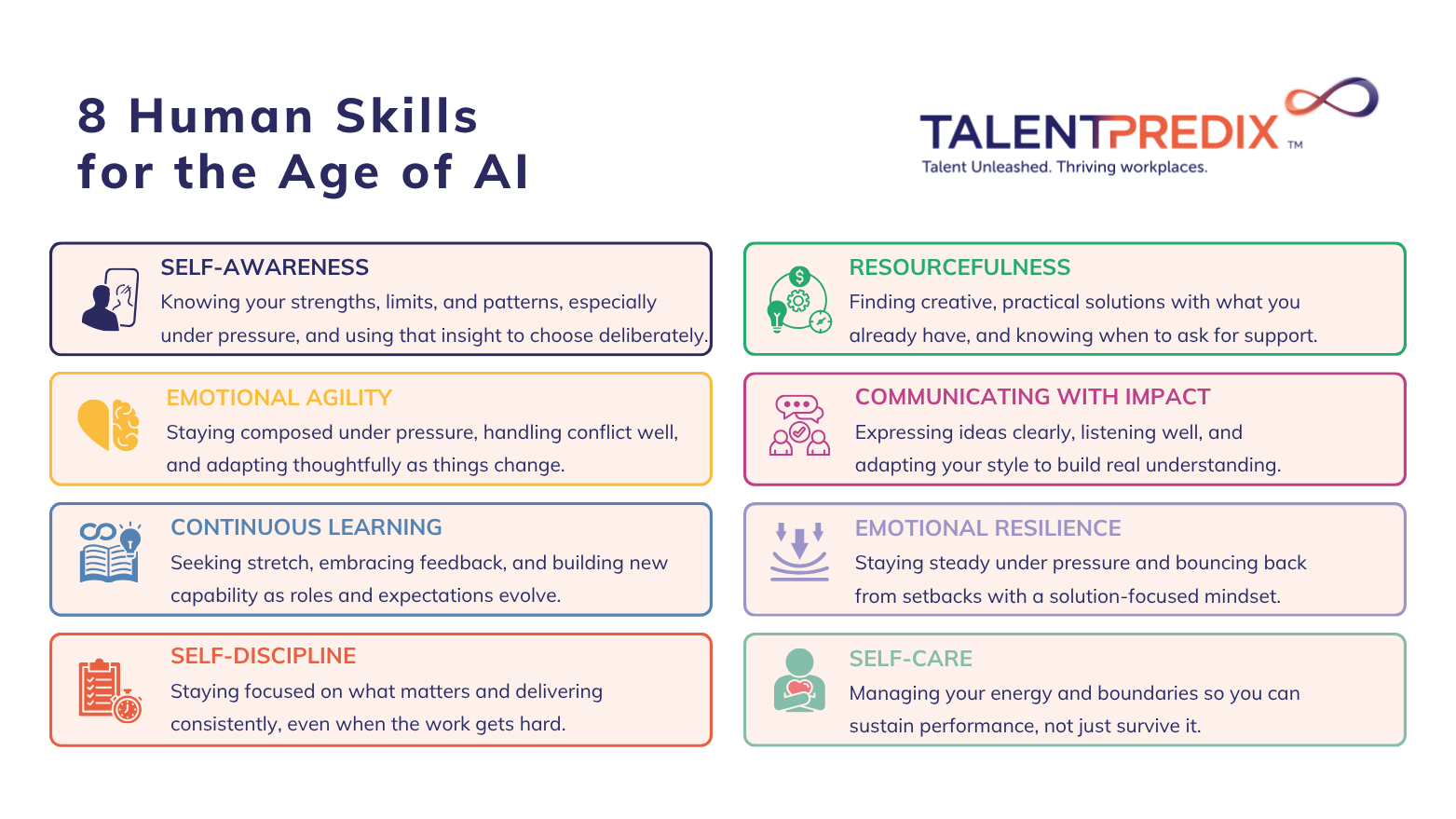
Self-care. Not spa days. Not work-life balance slogans on a poster.
The real, deliberate practice of managing your energy, protecting your recovery, and taking responsibility for the physical, mental, and emotional foundations that determine how well you perform, think, and lead.
Why Self-Care At Work Is Having Its Reckoning
For a long time, neglecting self-care was quietly rewarded:
- The first in, last out culture
- The leader who never takes a proper break
- The individual answering emails at midnight as proof of commitment
In many organizations, depletion was disguised as dedication.
High-achievers are often the ones to neglect self-care most. Their drive and need for achievement can become all-consuming – and they are frequently the last to recognize the cost.
We spend roughly 80,000 hours at work across a career: more waking time in the office than at home, over 40 to 50 years. It is hardly surprising that many people’s identities become so fused with their work that they feel anxious about disconnecting.
Mobile devices encourage an always-on mindset when boundaries are not actively maintained, and poor habits creep in gradually – distance from family and loved ones, and the quiet erosion of mental and physical health that follows.
“Depletion was disguised as dedication. That era is over – because the data is now too loud to ignore.”
The McKinsey Health Institute estimates that structuring workplaces to support holistic health could unlock up to US$1.7 trillion in global productive value.
Burnout – the direct, predictable consequence of sustained self-care failure – reduces creativity, increases errors and turnover, and is associated with elevated rates of depression and cardiovascular disease.
It is not a personal failing. It is a preventable organizational risk.
Work-Life Balance Is Not One-Size-Fits-All
It is worth remembering that work-life balance is deeply subjective.
| Some people need… | Others need… |
|---|---|
| Firm boundaries to function at their best | Flexibility to work when they feel most energized |
| Clear disconnection from work | More fluid patterns across evenings or weekends |
| Recovery built into the working day | Freedom to manage energy in their own way |
Some people are genuinely energized by working evenings and weekends; others need firm boundaries to function at their best. Neither is inherently wrong.
The goal is not to impose a single model, but to help people avoid the obsessive, all-consuming patterns that quietly undermine wellbeing – the ones that lead to burnout and, in the worst cases, to chronic health conditions that shorten both careers and lives.
The AI Era Is Making Self-Care Urgent
AI transformation is accelerating the pace of change, expanding cognitive load, and blurring the boundaries between work and everything else.
PwC’s 2025 Global Workforce Survey found that workers experiencing chronic fatigue, anger, or overwhelm are 30% less motivated. Only 33% of employees globally are currently thriving (Gallup, 2025).
These are the baseline conditions in which most organizations are asking people to adapt, upskill, and perform.
“AI doesn’t fix depletion. In many cases, it amplifies it – raising the cognitive load, compressing decision cycles, and removing the recovery buffers people didn’t even realize they were relying on.”
Building Self-Care Deliberately
Like all Self-Mastery skills, self-care at work is not a fixed trait. It can be built through deliberate practice.
Wellhub’s 2026 research across 5,000+ employees found that 89% perform better when they prioritize health through structured wellness practices.
The word ‘structured’ matters: ad hoc good intentions do not sustain under pressure. Systems do.
Practically, this means:
- Treating recovery as a performance input rather than a reward for completed work
- Designing boundaries around energy, not just time
- Ensuring coaching conversations explore the long-term sustainability of current performance patterns before depletion becomes derailment
“Self-care is not separate from leadership effectiveness. It is an integral part of it – the resource from which everything else is drawn.”
The Bigger Picture
Self-care is central to the Self-Mastery framework, not an afterthought.
| Without self-care… | The risk is… |
|---|---|
| Self-discipline without recovery | Depletion |
| Emotional resilience without restoration | Brittleness |
| High performance without sustainability | Burnout |
The eight skills are a system, and self-care is what keeps that system running.
The question is not whether your people are performing.
It’s whether the conditions exist for them to keep performing and thriving – not just this quarter, but throughout their career.
See Self-Care in Your Organization
Self-care is one of eight Self-Mastery skills measured in the TalentPredix™ 360 Self-Mastery Profile, alongside strengths, feedback, and the critical human skills people need to perform, adapt, and thrive in the Age of AI.
If you want to understand how self-care, resilience, emotional agility, resourcefulness, and the other Self-Mastery skills show up across your organization, request a free TalentPredix™ trial.
You’ll see how the profile works, what it reveals, and how it can support more focused development conversations for your people, leaders, and teams.
Request a free trial
Also useful
- Download the Self-Mastery white paper
- Prefer to listen? Listen to the Talent Trailblazers podcast episode
This is the second post in our Self-Mastery Series. Each week, we’re breaking down one of the eight skills, what it means, why it matters, and how to build it deliberately.

Author: James Brook
James Brook FCIPD is the Founder and Managing Director of TalentPredix™, a business psychologist, executive coach and talent and strengths assessment expert with more than 30 years’ international experience. He previously founded Strengthscope® and held senior HR and talent leadership roles at Yahoo!, NatWest and Novo Nordisk.

