
Here’s a challenge many of us can relate to: going to the gym on the day you really don’t want to.
Not the day you’re motivated. Not the day you’ve had a good night’s sleep and a decent breakfast and you’re feeling strong. The day where you’re tired, it’s freezing outside, the meeting ran over, and every rational-sounding voice in your head has a perfectly good reason why tomorrow would be better.
Self-discipline is what gets you there anyway. Everything else people call self-discipline is really just motivation wearing a disguise.
I open with the gym because it’s the cleanest example I know, and because most people, if they’re honest, already understand it intuitively about their bodies but haven’t transferred the lesson to their work. Nobody waits to feel like exercising. Elite athletes, runners, and other people who train consistently are not the ones with more willpower on tap than everyone else. They’re the ones who stopped needing to feel like it in the first place.
Self-discipline at work is what turns intention into action when motivation is no longer doing the work for you.
Self-discipline has an image problem, and the problem is that it’s true to its reputation: it is not exciting.
Emotional agility sounds like emotional depth. Self-awareness sounds like insight. Resourcefulness sounds like ingenuity. Self-discipline sounds like eating your vegetables and, in development conversations, in leadership offsites, and in the books people actually choose to read on a plane, it gets crowded out by more glamorous skills with better marketing.
Even the data reflects the bias. The World Economic Forum’s Future of Jobs Report 2025 tracks “dependability and attention to detail”, the closest proxy to self-discipline in its skills taxonomy, as one of the categories employers rank as declining in importance, even as resilience, agility, and leadership climb.
That’s not because dependability matters less. It’s because it’s unglamorous enough to get deprioritized in forecasting, right up until an organization badly needs it and discovers it isn’t there.
At TalentPredix™, self-discipline is one of the eight Self-Mastery skills, the Critical Human Skills people need to perform, adapt, and thrive in the Age of AI.

We define it as maintaining focus on priorities, managing distractions, and sustaining effort and quality when work becomes demanding. In practice, that means translating intentions into consistent action, even when motivation has run out.
A skill that only works when you feel like using it isn’t a skill. It’s a mood.
The most common mistake people make with self-discipline is treating low motivation as a problem to fix before they can act.
It doesn’t need fixing. It needs challenging.
Motivation is just a feeling, and feelings aren’t reliable guides to what matters. They shift with sleep, blood sugar, and how your last meeting went. Waiting for motivation to show up before you act is waiting for a coincidence, and procrastination is usually what fills that wait, dressed up as a plan.
“I’ll feel more like it tomorrow” is rarely true. It’s just easier to say than “I don’t want to do this right now.”
The gym floor at 6 a.m. is full of people who didn’t feel like it either. What’s different about them isn’t their feelings. It’s that they built a habit sturdy enough not to need their feelings’ permission.
That matters more than it sounds. We tend to assume some people are simply born disciplined and others aren’t, that it’s a fixed trait, like height. It isn’t. What actually separates them is mindset, habits, and self-efficacy: the belief that your own actions can produce the outcome you want.
Build that belief, alongside the right habit systems, and discipline stops being something you either have or don’t.
This is where self-discipline stops being a personality trait and starts being a mindset and habit-building opportunity, and there’s a growing body of research behind that shift.
Charles Duhigg’s The Power of Habit remains the clearest popular account of how this actually works, and its central idea, the habit loop, is worth applying directly to self-discipline at work.
Every habit, Duhigg argues, runs on three parts: a cue that triggers the behaviour, a routine that is the behaviour itself, and a reward that tells your brain the loop was worth repeating. Once that loop is established, the behaviour stops requiring conscious willpower. The brain hands it off to autopilot.
This reframes the whole problem. People assume disciplined colleagues are drawing on some deeper reserve of willpower than everyone else. Mostly, they’ve just built better, more consistent loops.
The person who reliably clears their inbox before lunch, or reliably prepares before a difficult conversation instead of winging it, isn’t fighting a daily battle of will. They’ve engineered a cue, a time, a location, or a preceding action, that fires the routine automatically, and a reward that closes the loop.
The discipline was in the design, not in the daily willpower spend.
The practical implication: if a behaviour at work keeps failing despite good intentions, the honest diagnosis is rarely “I need more willpower.” It’s usually “I haven’t built a loop.”
Fix the cue and the reward, and the routine gets a lot easier to sustain.
The other piece of research worth knowing changes how you should think about the early weeks of any new habit.
Most people have heard that habits take 21 days to form. However, that figure has no robust research behind it.
A more credible, peer-reviewed study led by Phillippa Lally at University College London tracked 96 people building a new daily behaviour over 12 weeks. The average time to reach automaticity was 66 days, and the range was 18 to 254 days, depending on the person and the behaviour.
Two things follow from that.
First, if a new discipline still feels effortful after three weeks, that is not failure. It is roughly on schedule. Most people quit in week two or three, at exactly the point the research says the behaviour is supposed to still feel hard.
Second, and just as usefully, Lally’s data also found that missing a single day here or there did not meaningfully derail the habit-formation curve.
Consistency matters more than perfection.
The gym-goer who skips a Tuesday and shows up Wednesday is still building the habit. The one who skips a Tuesday and decides the whole project has failed is the one who derails it.
Because self-discipline is closer to habit engineering than character, the development approach looks practical rather than inspirational.
Self-discipline isn’t only about pushing through the tasks in front of you. It’s equally about challenging the ones that shouldn’t be there in the first place.
Every “yes” to non-essential work undermines attention, energy, and focus, and the discipline to say “no” protects the same finite capacity and precious time you have.
Boundaries aren’t the opposite of discipline. They’re where it starts.
For individuals, the highest-leverage habit is reducing the friction between intention and action: lay the gym kit out the night before, block the calendar before the day fills up with other people’s priorities, and keep a simple decision checklist for the moments willpower is weakest.
Every extra decision in that moment is another chance to talk yourself out of it.
A second practice is attaching a reward that arrives immediately, not the distant one. “I’ll be healthier in six months” is a weak cue for showing up today. “Fifteen minutes to myself and a coffee afterward” works because the brain gets paid now, not eventually.
Managers build this in others less by giving advice on self-discipline and more by removing friction from the system: clear priorities instead of ever-changing ones, protected time instead of calendars assuming infinite availability, and recognition that lands close to the behaviour, not just at annual review.
Organizations build the capability structurally by making follow-through visible: checkpoints, shared trackers and scorecards, or simply a culture where “did we do what we said we’d do?” gets asked out loud and often.
Multi-rater feedback matters here too. Colleagues often spot a follow-through gap more accurately than the person does themselves, because the gap between intention and actual behaviour is exactly the blind spot self-perception struggles to surface.
For people with ADHD and other forms of neurodivergence, self-discipline can be genuinely harder to build, and that’s worth naming.
Starting tasks, holding a plan in mind, and resisting the pull of a more interesting distraction all draw on executive function, the brain’s system for inhibition, planning, and self-regulation. Russell Barkley’s research shows this is precisely where ADHD brains work differently.
Willpower was never built to compensate for that.
What tends to help instead is the same principle as the habit loop, just applied more deliberately: externalising the cue, using alarms and visible checklists instead of relying on memory, and shrinking the gap between routine and reward.
The goal isn’t more willpower. It’s building practical systems that empower the neurodivergent person and take the reliance off willpower altogether.
AI strips away a lot of the low-friction structure that used to carry us through mundane tasks.
Fewer fixed processes, fewer people checking in, more data and options on tap, and more autonomy over how and when work gets done. That sounds like freedom. For self-discipline, it’s a crucial stress test.
When the structure thins out and the cognitive load rises, your habit loops become the thing carrying you, because nobody else is going to notice a dropped ball as quickly as they used to.
The people who thrive in more autonomous, AI-augmented roles won’t be the ones with the most motivation.
They’ll be the ones whose follow-through doesn’t depend on it.
Good intentions are easy to overestimate. Follow-through is visible to other people.
TalentPredix™ Self-Mastery 360 combines strengths-based assessment with multi-rater feedback to help people see how Self-Discipline and the other Critical Human Skills show up in real working behaviour.
It gives individuals and organizations a clearer view of patterns around focus, consistency, priorities, and follow-through, creating a stronger foundation for practical development conversations.
Explore TalentPredix™ 360 to see how strengths-based feedback can support more focused, practical development for your people and leaders.
If you want to explore this topic further:
This is the sixth post in our Self-Mastery Series, where we break down each of the eight Critical Human Skills: what it means, why it matters, and how to build it deliberately.
Previous articles covered Resourcefulness, Self-Care, Continuous Learning, Emotional Agility, and Self-Awareness.
Next up: Communicating with Impact, and why saying the right thing isn’t the same as landing it.
A restructure is announced on a Monday. By Wednesday, a normally solid manager is snapping at questions in the weekly team meeting and has stopped replying to two peers he feels “should have warned him.”
He has quietly started polishing his CV instead of drafting the transition plan his director asked for. Nobody would call him unprofessional. He shows up, he delivers, and he says the right things in the town hall. But underneath the composure, he is reacting to every fresh piece of information as a threat, and his team can feel it.
Three weeks later, the change stalls in his part of the business, not because the plan was wrong, but because he never processed his own reaction to it enough to lead anyone else through theirs.
That manager doesn’t have a skills gap. He has an emotional agility gap, and it is one of the most common and least diagnosed reasons change initiatives fail.
Emotional agility at work is what allows people to experience the reaction without letting it dictate what they do next.
Gartner’s research found that employee willingness to support organizational change fell from 74% in 2016 to 43% by 2022. Over the same period, the number of planned enterprise changes the average employee experienced in a year rose from two to ten. Harvard Business Review reported these Gartner findings in 2023. Harvard Business Review
Most organizations read numbers like these and diagnose a change management problem. Better communications. Clearer roadmaps. More meetings.
I read them differently. What those numbers describe is an emotional capacity problem. People are not confused about what is changing. They are tired, apprehensive, and in many cases quietly angry about it, and most workplaces give them nowhere useful to take those feelings.
So the feelings go underground and resurface as resistance, cynicism, and disengagement.
The skill that determines whether people can move through change without being driven by their emotional reaction to it has a name: emotional agility. At TalentPredix™, it is one of the eight Self-Mastery skills, the Critical Human Skills people need to perform, adapt, and thrive in the Age of AI. TalentPredix™
We define it simply: regulating emotions to remain composed and responsive under pressure, handling conflict constructively, staying open to diverse perspectives, and adapting behaviour thoughtfully in uncertain or changing situations.
The key word is responsive. Not calm. Not controlled. Responsive.
Here is the distinction that makes emotional agility worth understanding properly.
Every difficult moment at work, a restructure announcement, a criticism in front of colleagues, a project cancelled after months of effort, produces an emotional reaction. That reaction is not optional. It arrives before conscious thought, and no amount of professionalism prevents it.
What is optional is what happens next. Between the emotional experience and the behavioural response there is a space, and emotional agility is the skill of using it well.
Psychologist Susan David’s research, which gave the concept its name, describes the alternative as getting “hooked”: treating a passing thought or feeling as a fact and acting from inside it. The manager who feels threatened by a restructure and starts quietly briefing against it. The leader who receives challenging feedback and spends the meeting defending rather than listening. Neither would describe themselves as emotional. Both are being steered by emotion they have not acknowledged. Harvard Business Review
David’s work points to a sequence agile responders use instead: notice the emotion, name it accurately, accept that it is there, then choose a response aligned with your values rather than your impulse.
It sounds simple. Under real pressure, it is one of the hardest disciplines in professional life.
Emotional intelligence (EQ) has earned its place in the conversation.
The World Economic Forum’s Future of Jobs Report 2025 lists empathy and active listening among the core skills employers expect workers to need, alongside capabilities including resilience, flexibility, agility, and continuous learning. World Economic Forum
Pearson’s Skills Outlook, built from an analysis of more than 21 million job ads across the US, UK, Canada, and Australia, found that the “power skills” employers are hiring for are overwhelmingly human ones, including collaboration, communication, leadership, and cultural and social intelligence. Pearson plc
So the evidence isn’t in question. My problem is with the meaning the term conveys and what it asks people to actually develop.
Start with the word “intelligence”. To many, it implies something fixed and cerebral, and whether EQ is really a form of intelligence at all is still disputed among psychologists. But set that debate aside.
In practice, most people use “emotional intelligence” to mean something narrower: noticing emotions accurately, yours and everyone else’s in the room.
Emotional agility is what happens after the noticing.
Not “can you name the emotion?” but “can you act well while it’s live?” That’s narrower, more coachable, and far easier to observe in someone’s actual behaviour, which is why it belongs in a skills framework, not left as a trait some leaders are assumed to have and others aren’t.
It’s also the more honest name for what breaks under pressure. Almost none of the leaders I coach through failed change programmes were unaware their team was anxious. They knew.
What they lacked was the trained ability to stay open, curious, and values-led while standing inside that anxiety themselves.
That’s agility. Not intelligence. And it’s what we assess and build in the Self-Mastery framework.
AI transformation is frequently treated as a technology programme with a training plan attached. In practice, it is one of the most emotionally loaded changes most workforces have experienced.
It touches identity: people who have built self-worth on expertise watch parts of that expertise become automatable.
It touches security: few leaders can honestly promise that every role is safe.
And it moves fast enough that the normal human process of adjusting to change never quite completes before the next change arrives.
In that environment, unprocessed emotion becomes an organizational force. Gartner’s research links change fatigue to eroded intent to stay and measurably reduced performance. Gartner
The World Economic Forum’s Future of Jobs Report 2025 ranks resilience, flexibility, and agility among the most important core skills identified by employers. World Economic Forum
Leaders with emotional agility do something distinctive here: they treat resistance as information rather than insubordination.
When a team pushes back on an AI rollout, the agile response is not to repeat the business case more loudly. It is to get curious about what the resistance is protecting, competence, fairness, identity, workload, and address that directly.
You cannot do this for others until you can first do it for yourself.
The manager in our opening example never got there. His team didn’t need more explanation of the restructure. They needed him to be steady enough to hear what they were actually worried about.
Emotional agility rarely announces itself. It shows up in small, observable behaviours:
Notice that none of these behaviours is emotionless.
In each case, the emotion is present, acknowledged, and working for the person rather than against them.
Like all Self-Mastery skills, emotional agility is not a fixed trait. It develops through practice, and the practice is specific.
For individuals, the foundational habit is accurate labelling. Research consistently shows that naming an emotion precisely, “I’m feeling defensive because that comment questioned my judgement” rather than “I’m stressed”, reduces its grip and restores access to deliberate thinking. Research on affect labelling has found reduced emotional reactivity when feelings are put into words. PubMed
A second habit is the neutral-observer reframe: taking a triggering situation and describing it as a fair-minded outsider would.
In our coaching work, we ask people to write both versions down. The gap between the two accounts is usually where the insight lives.
Managers and leaders shape the conditions more than they realize. Gartner’s research found that when managers create a psychologically safe team environment, change fatigue can fall by up to 46%. Gartner
Practically, this means:
Organizations build the skill structurally when they stop treating emotion as noise in the system.
Decision debriefs that ask “what was driving our thinking?” build collective agility. So does giving change programmes an explicit listening mechanism, so emotional response data reaches decision-makers while it can still shape the plan.
One connection worth making: emotional agility draws heavily on energy. A depleted person has a shorter fuse and a smaller space between feeling and response, one reason the self-care practices we covered earlier in this series are not a separate topic.
Regulation is expensive, and it is paid for in recovery.
There is a difference between a team that avoids conflict and a team that processes it.
| Reactive culture | Emotionally agile culture |
|---|---|
| Difficult feelings are managed privately, off to the side | Difficult feelings are named openly, as part of the work |
| Composure is mistaken for alignment | Behaviour under pressure is treated as the real signal |
| Resistance is read as a people problem | Resistance is read as project intelligence |
| Feedback is softened until it says nothing | Feedback is direct, and the reaction to it is coached |
| Change communication stops at “here’s what’s happening” | Change communication includes “here’s what this might bring up” |
This distinction matters because many organizations invest heavily in change communication, yet still watch adoption stall.
The issue is rarely a lack of information. It is usually a lack of somewhere for the emotional reaction to go.
There is a measurement problem with this skill: almost nobody experiences themselves as reactive.
We judge ourselves by our intentions and our inner narrative, while colleagues experience our tone, our timing, and our behaviour under pressure.
This is why multi-rater feedback is so valuable here.
In the TalentPredix™ 360 Self-Mastery Profile, emotional agility is assessed through both self-rating and observer feedback, alongside the other seven Critical Human Skills and the person’s Strengths, Motivations, and Values. TalentPredix™ currently positions Self-Mastery specifically for deeper development and adaptation through change. TalentPredix™
The most productive development conversations often start from the gap: a leader who rates themselves composed and open, whose colleagues report walking on eggshells before delivering difficult news.
That gap is not an accusation.
It is a starting point, and in our experience, one of the fastest routes to genuine behavioural change, because it replaces argument about intentions with evidence about impact.
You can measure whether change lands. But do you know whether your people have the emotional capacity to carry it?
TalentPredix™ Self-Mastery 360 combines strengths-based assessment with multi-rater feedback to help people see how Emotional Agility and the other Critical Human Skills show up in real working behaviour, not just in their own self-perception.
It gives individuals and organizations a clearer view of the gap between intention and impact, creating a stronger foundation for development conversations around adaptability, resilience, self-awareness, and performance under pressure.
Explore TalentPredix™ 360 to see how strengths-based feedback can support more focused, practical development for your people and leaders.
If you want to explore this topic further:
This is the fourth post in our Self-Mastery Series, where we break down each of the eight Critical Human Skills: what it means, why it matters, and how to build it deliberately.
Next up: Self-Awareness, and why it cannot be built through self-perception alone.
Here’s an uncomfortable truth for every person reading this: a growing share of the skills that got you where you are today will not get you where you are going.
The World Economic Forum estimates that around two-fifths of workers’ core skills will change by 2030. The obsolescence rate of many technical skills is now measured in a handful of years, and that window is shrinking fast.
In a world moving this quickly, what you know still matters. But it matters less than how quickly you can learn what comes next.
Most organizations are responding to this by building more detailed skills inventories: taxonomies, frameworks, dashboards, and capability maps. These are useful, but they are incomplete.
A skills inventory tells you what people know today. It tells you far less about the one variable that determines whether that inventory will still be accurate in two years: how fast your people can learn, unlearn, and adapt.
That is why, at TalentPredix™, continuous learning is one of the eight Self-Mastery skills: the critical human skills people need to understand, assess, and develop to perform, adapt, and thrive in the Age of AI.
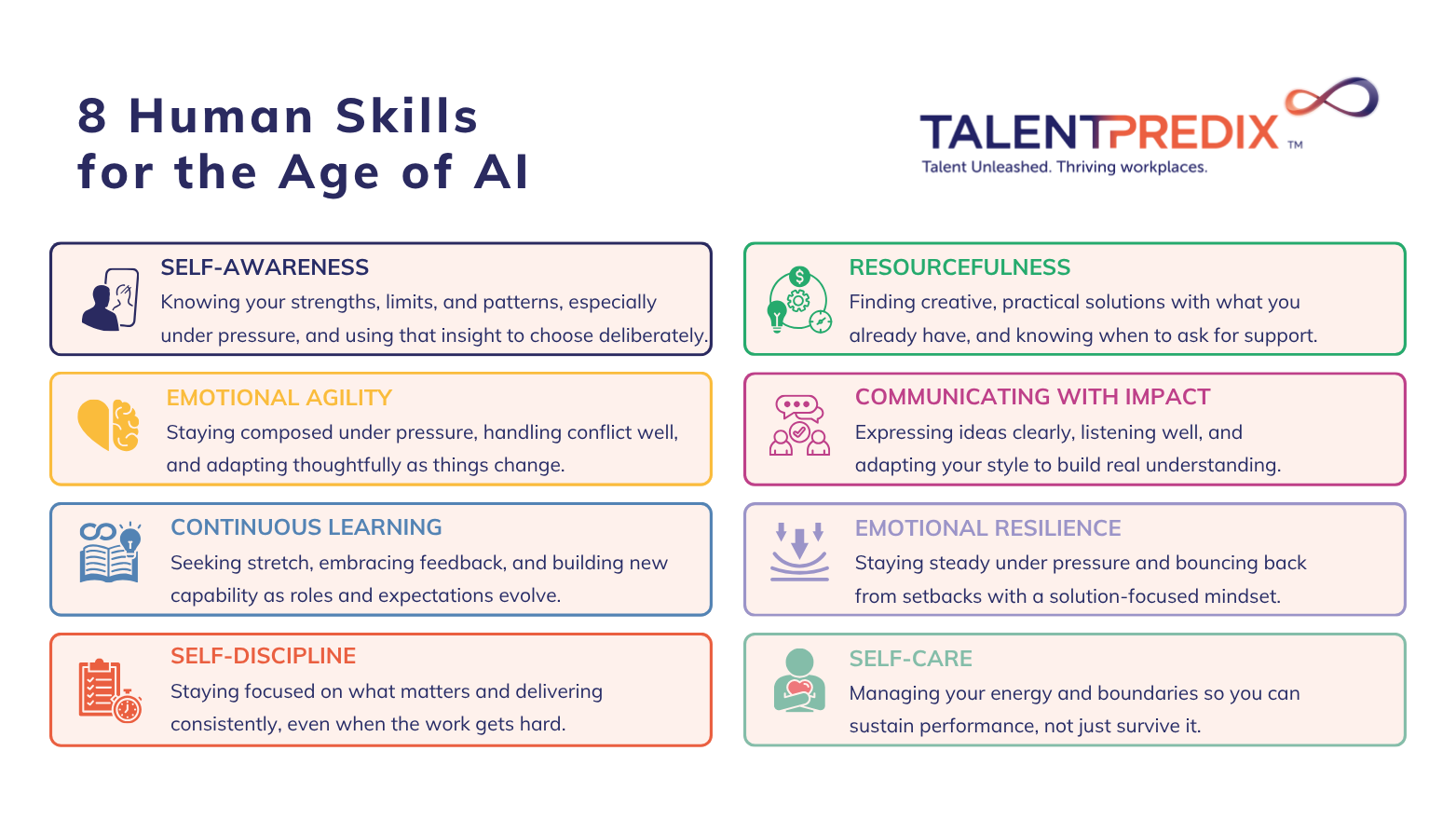
We define continuous learning simply: continuously seeking to learn, improve, and embrace opportunities for personal and professional development.
Not courses for the sake of courses. Not compliance training. Not another well-meaning learning platform that people open twice and forget. The real skill is the deliberate habit of stretching beyond what you already know and treating every challenge, setback, and unfamiliar situation as an opportunity for growth.

For years, learning was treated as something separate from work.
You did your job. Then, occasionally, you attended training. Maybe you completed an online module. Maybe you had a development conversation once a year, usually squeezed into a performance review that was already trying to do too much.
That model no longer works.
Roles are changing too quickly. AI is reshaping tasks, expectations, and workflows. Skills that looked valuable a few years ago are becoming easier to automate, while other skills are rising in importance almost overnight.
The question for HR, L&D, and talent leaders is no longer just: what skills do our people have?
It is: how quickly can our people learn what comes next?
That is learning capacity. And it is becoming one of the most important predictors of whether individuals, teams, and organizations can stay relevant through change.
Skills data matters. It helps organizations understand current capability, workforce gaps, internal mobility opportunities, and development priorities.
But on its own, it can become dangerously static.
| A skills inventory shows… | Learning capacity shows… |
|---|---|
| What people know today | How quickly people can learn tomorrow |
| Current technical capability | Adaptability under changing conditions |
| Role fit now | Growth potential over time |
| Existing skills gaps | Ability to close those gaps |
| What may need training | Who is most ready to stretch, unlearn, and improve |
A person may have the right skills today, but little appetite to adapt tomorrow. Another person may not yet have the full skill set, but may show strong curiosity, feedback-seeking, experimentation, and adaptability.
In a fast-changing environment, that second person may be the better long-term bet.
The most resilient talent strategies will not only identify current capability. They will identify the people most likely to grow into what comes next.
That is why talent development needs to move beyond static skills mapping and start asking sharper questions about learning agility, motivation, and adaptability.
Continuous learning is the skill that underpins and renews all the others.
Every other skill has a shelf life. Technical knowledge expires. Tools change. Best practice moves. Even leadership expectations evolve as the world of work changes around us.
Continuous learning is what keeps people current.
The research base here is deep. Carol Dweck’s work on growth mindset shows that people who believe capability can be developed are more likely to persist through challenge, seek feedback, and treat setbacks as part of learning.
The retention evidence is also hard to ignore. LinkedIn’s Workplace Learning Report consistently highlights learning and career growth as major factors in whether people stay with an organization or look elsewhere.
That matters because development is no longer just a benefit. For many people, it is part of the psychological contract.
If people feel they are growing, they are more likely to stay engaged, adaptable, and future-focused. If they feel their growth has stalled, they start looking for movement elsewhere.
As I argued in Resourcefulness: The Under-the-Radar Super Skill of the AI Age, uncertainty rarely arrives as one dramatic event. It usually shows up as a steady stream of new tools, shifting priorities, unclear problems, and unfamiliar expectations.
Continuous learners do not wait for the training calendar to catch up. They close the gap themselves.
AI has not just made learning more important. It has made it non-negotiable.
Every wave of AI capability redraws the boundary between what machines can do and what humans add. The people who thrive will not simply be those with the most accumulated knowledge. AI has commoditized access to information.
What it has not commoditized is the appetite and agility to keep acquiring, testing, and applying new insight.
That is where continuous learning becomes a serious performance skill. It shows up when someone learns a new tool before they are formally trained on it, unlearns an outdated process without ego, asks better questions than the technology can answer, or moves from “this is how we have always done it” to “what is now possible?”
This is also where continuous learning connects to energy and sustainability.
As I explored in Self-Care: The Human Skill We’ll All Need to Invest in to Thrive in the AI Era, growth depends on capacity as much as ambition. People cannot keep learning if they are depleted, distracted, or running on empty.
Learning is a renewable resource, but only if people protect the energy required to do it.
Continuous learning is not always dramatic. Often, it looks like small, repeated behaviours that compound over time.
It is the manager who asks for feedback after a difficult conversation. The employee who experiments with a new AI tool before being formally trained. The leader who admits an old approach is no longer working. The team that reviews what it learned from a failed project instead of rushing past it.
These behaviours matter because they change how people respond to uncertainty.
Instead of waiting for certainty, continuous learners create movement. Instead of protecting their existing expertise, they expand it. Instead of seeing change as a threat to competence, they treat it as an invitation to build new capability.
That is the difference between a workforce that is trained and a workforce that is adaptive.
Like all Self-Mastery skills, continuous learning is not fixed. It can be built through deliberate practice.
For individuals, that means developing habits such as:
That final point matters. Learning that depends on spare time rarely happens.
If learning is strategically important, it needs space, structure, and permission. Otherwise, it gets crushed by delivery pressure.
Organizations need to play their part too. The best create cultures where curiosity and experimentation are rewarded, questions are safe, and development conversations happen continuously, not only once a year.
That means managers need the insight, confidence, and language to support learning in the flow of work. Not vague encouragement. Not “keep developing yourself”. Specific, strengths-based conversations about what someone is ready to build next.
This is where strengths assessment, coaching, and feedback can play a powerful role. When people understand their Strengths, Motivations, Values, and Limiters, they can make better choices about where to grow, how to stretch, and what conditions will help them sustain progress.
There is a difference between offering training and building a learning culture.
One is an activity. The other is a capability.
| Training culture | Learning culture |
|---|---|
| Learning happens in formal sessions | Learning happens in the flow of work |
| Development is owned by HR or L&D | Development is shared by leaders, managers, and individuals |
| People wait for courses | People seek feedback, stretch, and experiment |
| Failure is quietly avoided | Failure is treated as useful data |
| Progress is measured by completion | Progress is measured by behaviour change |
This distinction matters because many organizations are investing heavily in learning infrastructure, but still struggling to build real adaptability.
The issue is not always a lack of content. Often, it is a lack of learning behaviour.
Continuous learning is the bridge between development strategy and actual behaviour change.
You measure skills. But are you measuring learning capacity?
A skills inventory can show what your people know today. It cannot tell you whether they are ready to adapt tomorrow.
TalentPredix™ 360 helps organizations assess and develop the critical human skills that keep people performing, adapting, and growing in the Age of AI, including Continuous Learning.
It combines strengths-based assessment with 360-degree feedback, giving individuals and organizations a clearer view of how Strengths, Motivations, Values, and Self-Mastery skills show up in real working behaviour.
For HR, L&D, and talent leaders, this creates a stronger foundation for development conversations, coaching, leadership growth, internal mobility, and future-ready workforce planning.
If your organization is serious about building adaptability, start by measuring the human skills that make adaptation possible.
Request a free TalentPredix™ trial to see how Continuous Learning and the other Self-Mastery skills show up in practice.
If you want to explore this topic further, these resources are a useful next step:
This is the third post in our Self-Mastery Series. Each week, we are breaking down one of the eight critical human skills: what it means, why it matters, and how to build it deliberately.
Sarah’s manager pulled her aside last Tuesday. “We need you to lead the AI implementation project,” he said. “It’s a stretch, but I know you can handle it.”
Sarah smiled and nodded. Inside, she felt her stomach drop.
She’d never led anything this big. She barely understood the technology. And her manager’s words—”I know you can handle it”—felt less like confidence and more like a polite way of saying: “Figure it out on your own.”
Three months later, Sarah was working 70-hour weeks, second-guessing every decision, and dreading Monday mornings. The stretch didn’t make her stronger. It nearly broke her.
We’re told constantly that growth lives outside our comfort zone. That discomfort is the price of progress. That we should embrace being stretched.
And it’s true, to a point.
In today’s workplace, growth isn’t optional. AI, digital transformation, shifting customer expectations, and relentless disruption mean both leaders and employees must adapt faster than ever before. Staying comfortable isn’t safe anymore. It’s a path to stagnation, declining relevance, and missed opportunities.
But here’s what nobody talks about: stretch without support doesn’t build capability. It destroys it.
When people are pushed into unfamiliar territory without clarity, resources, or psychological safety, the result isn’t growth. It’s anxiety, resistance, and burnout. The very opposite of what organizations need.
The challenge isn’t choosing between stretch or safety. It’s learning how to combine them effectively.
Not all stretch is created equal. There’s a world of difference between positive, energizing stretch and negative, depleting stretch—but most organizations treat them identically.
Positive stretch challenges people to grow in areas aligned with their natural strengths. It builds on what they already do well, asking them to do it at a higher level, in a new context, or with greater complexity.
Example: A naturally analytical person is asked to lead a data-driven strategy project for the first time. The task is unfamiliar, but it plays to their core strengths. The challenge feels energizing, not draining. With the right support, they thrive.
Negative stretch forces people repeatedly into areas that drain their energy, sit far outside their natural talents, or lack adequate support.
Example: That same analytical person is told to lead a client relationship role requiring constant networking, emotional reading of social dynamics, and improvised small talk. Every day feels like swimming upstream. The harder they try, the more exhausted they become.
The first builds confidence and capability. The second erodes engagement and wellbeing.
Most organizations don’t distinguish between the two. They stretch people indiscriminately, assuming pressure creates diamonds. Sometimes it does. Often, it just creates damage.
Psychological safety is what transforms stretch from threatening to energizing.
When people feel safe to ask questions, admit uncertainty, experiment, and occasionally fail, they lean into challenge. They take intelligent risks. They learn rapidly.
When they don’t feel safe, they do the opposite. They hide problems. They avoid risks. They pretend to understand when they don’t. Learning stops. Performance suffers.
Here’s the mistake leaders make: they think psychological safety means lowering standards or avoiding accountability. It doesn’t.
Psychological safety means creating conditions where high standards and learning can coexist. Where people can be both challenged and supported. Where “I don’t know yet, but I’ll figure it out” is an acceptable, even valued, response.
Think about the best leader you’ve ever worked for. Chances are, they held you to high standards while also making it safe to struggle, ask for help, and learn as you went. That’s the combination that unlocks performance.
Most leaders genuinely want to develop their people. But good intentions collide with reality in predictable ways:
To do better, leaders need a clear, evidence-based view of people’s strengths, motivations, and natural working styles. Not assumptions or gut feel. Actual data.
Tools like TalentPredix provide this clarity, revealing where individuals are most likely to grow with energy rather than drain. This allows leaders to:
When you understand where someone’s energy comes from, you can design stretch that builds them up instead of wearing them down.
The Leader’s Balancing Act
Effective leaders create stretch and safety simultaneously. Here’s how:
They clarify expectations. Ambiguity kills psychological safety. People need to know what success looks like, where they have autonomy, and what support is available.
They normalize learning. They talk openly about their own uncertainties and mistakes. They model asking for help rather than being “know-it-alls”. They treat “I need to learn this” as a sign of engagement, not weakness.
They provide resources, not just pressure. Stretch works when people have time, tools, coaching, and access to expertise. Without resources and support, stretch becomes a setup for failure.
They check in on energy, not just output. They ask: “How sustainable does this feel?” Not just: “Are you getting it done?”
They celebrate learning, not just results. When someone tries something new, learns from it, and adjusts—that’s valuable even if the outcome wasn’t perfect.
They intervene when stretch becomes strain. They recognize the warning signs: declining quality, withdrawal, defensiveness, overwork. And they act before burnout sets in.
Remember Sarah, the one thrown into the AI project?
Here’s how her story could have gone differently:
Her manager says: “I’d like you to lead this AI implementation. It’s a big stretch, and I think it aligns with your analytical strengths and your interest in transformation work. Here’s what would set you up for success: weekly check-ins with me, access to our AI consultant for questions, and permission to say no to other projects so you can focus. I don’t expect you to know everything on day one. I do expect you to ask good questions and bring me challenges early. What do you think?”
That’s positive stretch with psychological safety.
In a world changing at breakneck speed, sustainable performance won’t come from relentless pressure. It will come from environments where people are challenged in ways that energize them and supported in ways that make learning possible.
Stretch that builds energy, not burnout.
Safety that enables performance, not comfort.
Organizations that strike this balance won’t just keep pace with change. They’ll shape it.
In a constantly changing workplace, the answer is not less challenge. It is better design. Stretch aligned to strengths. Psychological safety that enables learning. Clear expectations and real support.
TalentPredix helps organizations understand where energy comes from, where strain is likely, and how to design development that builds sustainable performance.
If you are serious about creating growth without burnout, book a conversation with us or request a demo to see how it works in practice.