
After more than 30 years coaching leaders and talented people across some of the world’s most successful organizations, one pattern stands out above almost all others:
The more driven people are, the harder they find it to stop – and the higher the potential risks to their health, relationships and long-term performance.
Not because they lack self-awareness, but because the drive that got them there doesn’t come with an off switch – it becomes obsessive.
At TalentPredix™, self-care is one of the eight Self-Mastery skills – the critical human skills that help people perform, adapt, and thrive in the Age of AI.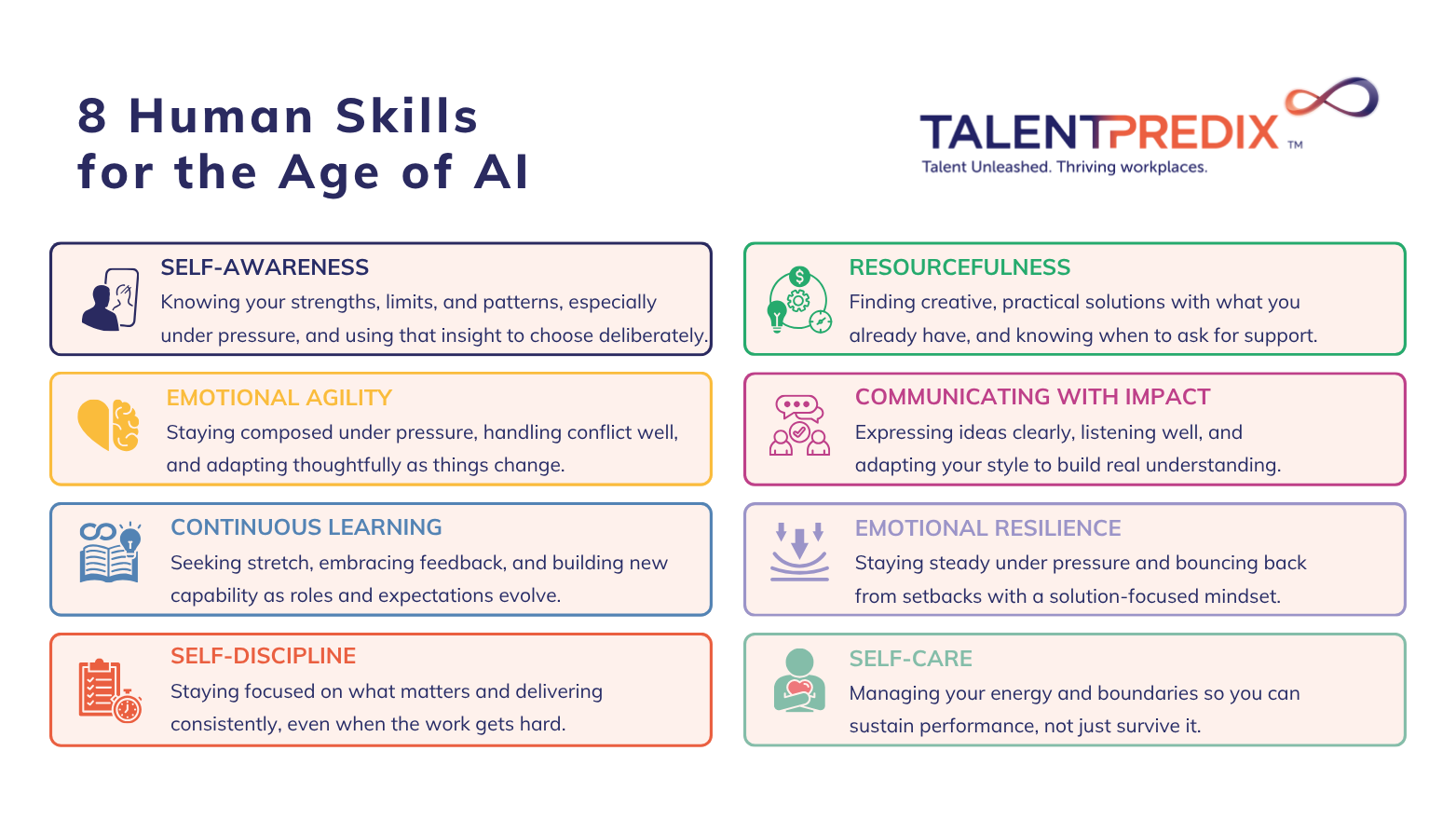
Self-care. Not spa days. Not work-life balance slogans on a poster.
The real, deliberate practice of managing your energy, protecting your recovery, and taking responsibility for the physical, mental, and emotional foundations that determine how well you perform, think, and lead.
For a long time, neglecting self-care was quietly rewarded:
In many organizations, depletion was disguised as dedication.
High-achievers are often the ones to neglect self-care most. Their drive and need for achievement can become all-consuming – and they are frequently the last to recognize the cost.
We spend roughly 80,000 hours at work across a career: more waking time in the office than at home, over 40 to 50 years. It is hardly surprising that many people’s identities become so fused with their work that they feel anxious about disconnecting.
Mobile devices encourage an always-on mindset when boundaries are not actively maintained, and poor habits creep in gradually – distance from family and loved ones, and the quiet erosion of mental and physical health that follows.
“Depletion was disguised as dedication. That era is over – because the data is now too loud to ignore.”
The McKinsey Health Institute estimates that structuring workplaces to support holistic health could unlock up to US$1.7 trillion in global productive value.
Burnout – the direct, predictable consequence of sustained self-care failure – reduces creativity, increases errors and turnover, and is associated with elevated rates of depression and cardiovascular disease.
It is not a personal failing. It is a preventable organizational risk.
It is worth remembering that work-life balance is deeply subjective.
| Some people need… | Others need… |
|---|---|
| Firm boundaries to function at their best | Flexibility to work when they feel most energized |
| Clear disconnection from work | More fluid patterns across evenings or weekends |
| Recovery built into the working day | Freedom to manage energy in their own way |
Some people are genuinely energized by working evenings and weekends; others need firm boundaries to function at their best. Neither is inherently wrong.
The goal is not to impose a single model, but to help people avoid the obsessive, all-consuming patterns that quietly undermine wellbeing – the ones that lead to burnout and, in the worst cases, to chronic health conditions that shorten both careers and lives.
AI transformation is accelerating the pace of change, expanding cognitive load, and blurring the boundaries between work and everything else.
PwC’s 2025 Global Workforce Survey found that workers experiencing chronic fatigue, anger, or overwhelm are 30% less motivated. Only 33% of employees globally are currently thriving (Gallup, 2025).
These are the baseline conditions in which most organizations are asking people to adapt, upskill, and perform.
“AI doesn’t fix depletion. In many cases, it amplifies it – raising the cognitive load, compressing decision cycles, and removing the recovery buffers people didn’t even realize they were relying on.”
Like all Self-Mastery skills, self-care at work is not a fixed trait. It can be built through deliberate practice.
Wellhub’s 2026 research across 5,000+ employees found that 89% perform better when they prioritize health through structured wellness practices.
The word ‘structured’ matters: ad hoc good intentions do not sustain under pressure. Systems do.
Practically, this means:
“Self-care is not separate from leadership effectiveness. It is an integral part of it – the resource from which everything else is drawn.”
Self-care is central to the Self-Mastery framework, not an afterthought.
| Without self-care… | The risk is… |
|---|---|
| Self-discipline without recovery | Depletion |
| Emotional resilience without restoration | Brittleness |
| High performance without sustainability | Burnout |
The eight skills are a system, and self-care is what keeps that system running.
The question is not whether your people are performing.
It’s whether the conditions exist for them to keep performing and thriving – not just this quarter, but throughout their career.
Self-care is one of eight Self-Mastery skills measured in the TalentPredix™ 360 Self-Mastery Profile, alongside strengths, feedback, and the critical human skills people need to perform, adapt, and thrive in the Age of AI.
If you want to understand how self-care, resilience, emotional agility, resourcefulness, and the other Self-Mastery skills show up across your organization, request a free TalentPredix™ trial.
You’ll see how the profile works, what it reveals, and how it can support more focused development conversations for your people, leaders, and teams.
This is the second post in our Self-Mastery Series. Each week, we’re breaking down one of the eight skills, what it means, why it matters, and how to build it deliberately.
As we head into 2026, the challenges and opportunities ahead demand more than another list of resolutions that won’t survive January. Thriving in an age of rapid change, complexity and disruption starts with inner change – how we think, our daily habits, and how we relate to others. The foundations of emotional and psychological wellbeing are now core to performance, resilience and effectiveness, not side notes.
Everything begins with mindset. The way we interpret setbacks, ambiguity and pressure shapes our experience and our performance. Rather than reacting automatically to challenges, choose to see them as opportunities for learning and growth. This doesn’t mean ignoring difficulty and tough challenges. It means consciously directing your energy toward constructive and considered responses. As many wellbeing experts highlight, negative thinking or fear-based responses can create a spiral of frustration and anxiety, whereas choosing a purposeful, growth-oriented mindset fuels resilience, clarity, agility, and creative problem-solving.
Humans are wired for connection, and the quality of our relationships deeply influences our emotional wellbeing and professional effectiveness. Research on wellbeing shows that supportive, energising connections create belonging, boost morale and provide the emotional resources needed to navigate stress. This is not about surrounding yourself only with mirrors and positive people, it’s about building a network of people who challenge you, support you, energize you and help you grow.
Time management alone won’t get you through the complexity of modern work. What matters even more is how you manage your energy – physically, emotionally, mentally and spiritually. Regular rest, reflective practices, and intentional boundaries replenish your capacity to think deeply and act decisively. Just as wellbeing models emphasise holistic health, investing in your emotional and psychological fuel enables sustained performance, not short spikes of productivity.
Remember that sleep is not a luxury; it’s essential to achieve mental clarity, peak performance and wellbeing. Aim for 7–8 hours a night, and switch off technology by around 9 p.m. if you can. Blue Zone longevity research consistently highlights sleep, strong evening routines and time with loved ones as foundations of long, healthy lives—reminding us that rest and connection, not constant digital stimulation, are what truly sustain performance and flow.
That age-old advice about working on weaknesses misses the bigger point: lasting impact and career success comes from amplifying your natural talents and strengths. When you apply and amplify your strengths with purpose to make a real difference at work and beyond, your engagement rises and your performance accelerates. This doesn’t mean ignoring opportunities for improvement; however, it does mean focusing performance and development on areas where you are most likely to add greatest value and feel most energized.
Optimism is a choice, not a denial of reality. In uncertain and tough times, balancing hope with realism helps people make better decisions and stay resilient. Progress rarely comes from dramatic breakthroughs; it comes from small, consistent improvements. When people notice what’s working, build on small wins, and believe that progress is possible, hope grows, and with it, wellbeing, momentum and sustained performance.
Transformative change rarely comes from grand gestures or overly ambitious goals. As the saying goes, we are a product of our daily habits. Instead, choose one habit that genuinely supports your wellbeing, energy and sense of purpose – whether that’s reflection, intentional breaks, or connecting regularly with someone who matters. Small, consistent actions may feel insignificant in the moment, but through the compound effect they build into greater clarity, energy and purpose over time.
Rather than dramatic leaps, ask yourself a grounded question: What’s one decision you’ve been postponing that could meaningfully improve how you live or work? Change worth investing in often starts with one intentional choice made today rather than tomorrow.
Thriving in 2026 doesn’t come from doing more; it comes from becoming more intentional, more resilient, and more connected. The inner work on mindset, relationships and wellbeing now pays dividends in performance, fulfilment and impact in the years to come.
That’s the trap. Thriving in 2026 is less about pushing harder and more about building clarity, energy, and strengths-led momentum. TalentPredix helps organizations and individuals turn self-insight into practical action through strengths assessment, strengths-based development, and feedback that actually fuels growth. If you want to build a more resilient, high-performing culture, book a demo or get in touch.