


Continuous Learning: The Skill That Keeps Every Other Skill Alive
Here’s an uncomfortable truth for every person reading this: a growing share of the skills that got you where you are today will not get you where you are going.
The World Economic Forum estimates that around two-fifths of workers’ core skills will change by 2030. The obsolescence rate of many technical skills is now measured in a handful of years, and that window is shrinking fast.
In a world moving this quickly, what you know still matters. But it matters less than how quickly you can learn what comes next.
Most organizations are responding to this by building more detailed skills inventories: taxonomies, frameworks, dashboards, and capability maps. These are useful, but they are incomplete.
A skills inventory tells you what people know today. It tells you far less about the one variable that determines whether that inventory will still be accurate in two years: how fast your people can learn, unlearn, and adapt.
That is why, at TalentPredix™, continuous learning is one of the eight Self-Mastery skills: the critical human skills people need to understand, assess, and develop to perform, adapt, and thrive in the Age of AI.
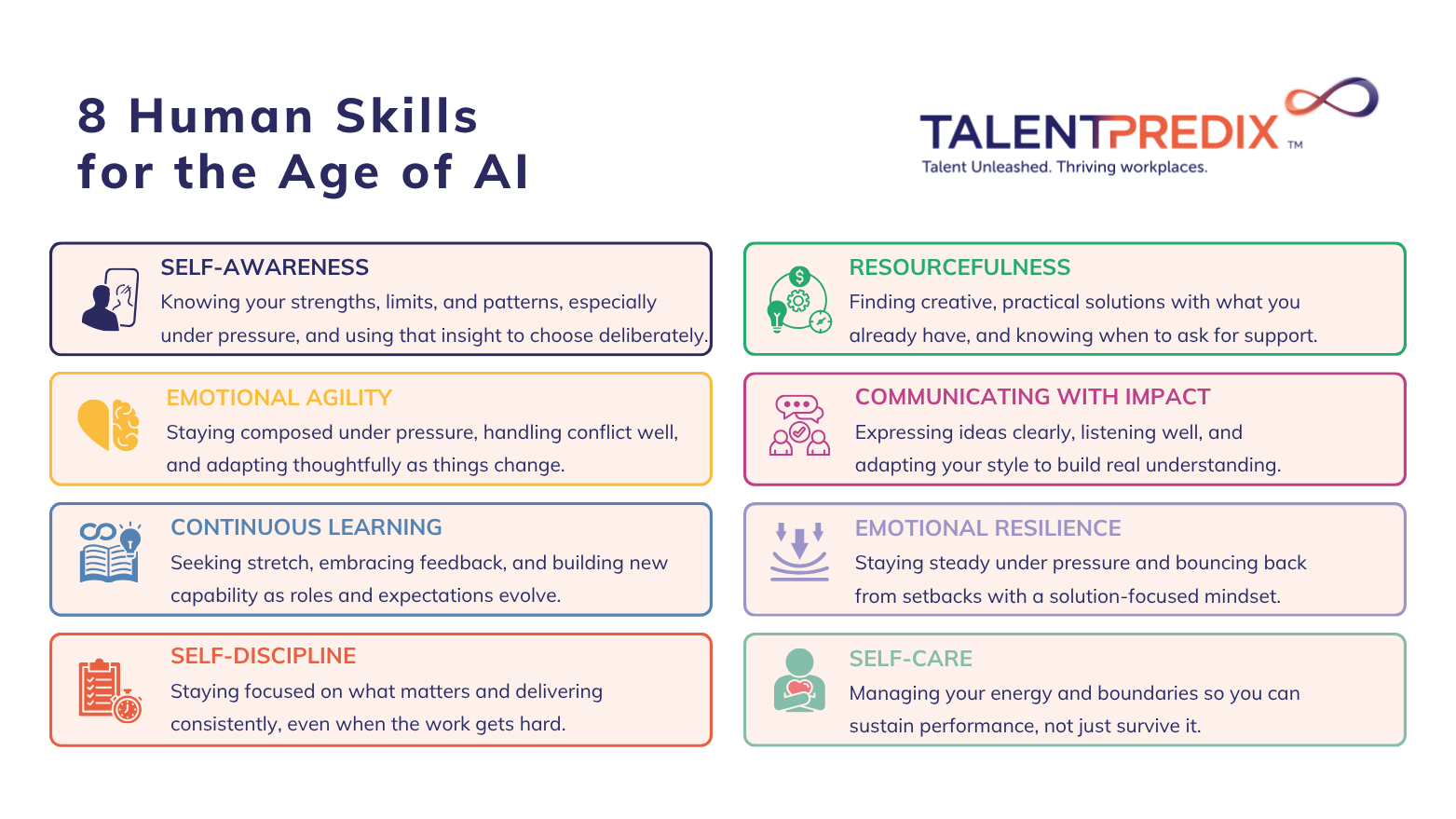
We define continuous learning simply: continuously seeking to learn, improve, and embrace opportunities for personal and professional development.
Not courses for the sake of courses. Not compliance training. Not another well-meaning learning platform that people open twice and forget. The real skill is the deliberate habit of stretching beyond what you already know and treating every challenge, setback, and unfamiliar situation as an opportunity for growth.
Why Continuous Learning at Work Matters Now

For years, learning was treated as something separate from work.
You did your job. Then, occasionally, you attended training. Maybe you completed an online module. Maybe you had a development conversation once a year, usually squeezed into a performance review that was already trying to do too much.
That model no longer works.
Roles are changing too quickly. AI is reshaping tasks, expectations, and workflows. Skills that looked valuable a few years ago are becoming easier to automate, while other skills are rising in importance almost overnight.
The question for HR, L&D, and talent leaders is no longer just: what skills do our people have?
It is: how quickly can our people learn what comes next?
That is learning capacity. And it is becoming one of the most important predictors of whether individuals, teams, and organizations can stay relevant through change.
Skills Data Is Useful. But It Is Not Enough.
Skills data matters. It helps organizations understand current capability, workforce gaps, internal mobility opportunities, and development priorities.
But on its own, it can become dangerously static.
| A skills inventory shows… | Learning capacity shows… |
|---|---|
| What people know today | How quickly people can learn tomorrow |
| Current technical capability | Adaptability under changing conditions |
| Role fit now | Growth potential over time |
| Existing skills gaps | Ability to close those gaps |
| What may need training | Who is most ready to stretch, unlearn, and improve |
A person may have the right skills today, but little appetite to adapt tomorrow. Another person may not yet have the full skill set, but may show strong curiosity, feedback-seeking, experimentation, and adaptability.
In a fast-changing environment, that second person may be the better long-term bet.
The most resilient talent strategies will not only identify current capability. They will identify the people most likely to grow into what comes next.
That is why talent development needs to move beyond static skills mapping and start asking sharper questions about learning agility, motivation, and adaptability.
Why Continuous Learning Is the Meta-Skill
Continuous learning is the skill that underpins and renews all the others.
Every other skill has a shelf life. Technical knowledge expires. Tools change. Best practice moves. Even leadership expectations evolve as the world of work changes around us.
Continuous learning is what keeps people current.
The research base here is deep. Carol Dweck’s work on growth mindset shows that people who believe capability can be developed are more likely to persist through challenge, seek feedback, and treat setbacks as part of learning.
The retention evidence is also hard to ignore. LinkedIn’s Workplace Learning Report consistently highlights learning and career growth as major factors in whether people stay with an organization or look elsewhere.
That matters because development is no longer just a benefit. For many people, it is part of the psychological contract.
If people feel they are growing, they are more likely to stay engaged, adaptable, and future-focused. If they feel their growth has stalled, they start looking for movement elsewhere.
As I argued in Resourcefulness: The Under-the-Radar Super Skill of the AI Age, uncertainty rarely arrives as one dramatic event. It usually shows up as a steady stream of new tools, shifting priorities, unclear problems, and unfamiliar expectations.
Continuous learners do not wait for the training calendar to catch up. They close the gap themselves.
The AI Connection
AI has not just made learning more important. It has made it non-negotiable.
Every wave of AI capability redraws the boundary between what machines can do and what humans add. The people who thrive will not simply be those with the most accumulated knowledge. AI has commoditized access to information.
What it has not commoditized is the appetite and agility to keep acquiring, testing, and applying new insight.
That is where continuous learning becomes a serious performance skill. It shows up when someone learns a new tool before they are formally trained on it, unlearns an outdated process without ego, asks better questions than the technology can answer, or moves from “this is how we have always done it” to “what is now possible?”
This is also where continuous learning connects to energy and sustainability.
As I explored in Self-Care: The Human Skill We’ll All Need to Invest in to Thrive in the AI Era, growth depends on capacity as much as ambition. People cannot keep learning if they are depleted, distracted, or running on empty.
Learning is a renewable resource, but only if people protect the energy required to do it.
What Continuous Learning Looks Like in Practice
Continuous learning is not always dramatic. Often, it looks like small, repeated behaviours that compound over time.
It is the manager who asks for feedback after a difficult conversation. The employee who experiments with a new AI tool before being formally trained. The leader who admits an old approach is no longer working. The team that reviews what it learned from a failed project instead of rushing past it.
These behaviours matter because they change how people respond to uncertainty.
Instead of waiting for certainty, continuous learners create movement. Instead of protecting their existing expertise, they expand it. Instead of seeing change as a threat to competence, they treat it as an invitation to build new capability.
That is the difference between a workforce that is trained and a workforce that is adaptive.
Building Continuous Learning Deliberately
Like all Self-Mastery skills, continuous learning is not fixed. It can be built through deliberate practice.
For individuals, that means developing habits such as:
- Setting stretch goals just beyond current capability
- Seeking feedback actively rather than waiting for it
- Reflecting on failure as data, not as a verdict
- Unlearning outdated ways of working without defensiveness
- Protecting time for learning, rather than leaving it to spare time
That final point matters. Learning that depends on spare time rarely happens.
If learning is strategically important, it needs space, structure, and permission. Otherwise, it gets crushed by delivery pressure.
Organizations need to play their part too. The best create cultures where curiosity and experimentation are rewarded, questions are safe, and development conversations happen continuously, not only once a year.
That means managers need the insight, confidence, and language to support learning in the flow of work. Not vague encouragement. Not “keep developing yourself”. Specific, strengths-based conversations about what someone is ready to build next.
This is where strengths assessment, coaching, and feedback can play a powerful role. When people understand their Strengths, Motivations, Values, and Limiters, they can make better choices about where to grow, how to stretch, and what conditions will help them sustain progress.
From Training Culture to Learning Culture
There is a difference between offering training and building a learning culture.
One is an activity. The other is a capability.
| Training culture | Learning culture |
|---|---|
| Learning happens in formal sessions | Learning happens in the flow of work |
| Development is owned by HR or L&D | Development is shared by leaders, managers, and individuals |
| People wait for courses | People seek feedback, stretch, and experiment |
| Failure is quietly avoided | Failure is treated as useful data |
| Progress is measured by completion | Progress is measured by behaviour change |
This distinction matters because many organizations are investing heavily in learning infrastructure, but still struggling to build real adaptability.
The issue is not always a lack of content. Often, it is a lack of learning behaviour.
Continuous learning is the bridge between development strategy and actual behaviour change.
Assess and Develop Continuous Learning in Your Organization
You measure skills. But are you measuring learning capacity?
A skills inventory can show what your people know today. It cannot tell you whether they are ready to adapt tomorrow.
TalentPredix™ 360 helps organizations assess and develop the critical human skills that keep people performing, adapting, and growing in the Age of AI, including Continuous Learning.
It combines strengths-based assessment with 360-degree feedback, giving individuals and organizations a clearer view of how Strengths, Motivations, Values, and Self-Mastery skills show up in real working behaviour.
For HR, L&D, and talent leaders, this creates a stronger foundation for development conversations, coaching, leadership growth, internal mobility, and future-ready workforce planning.
If your organization is serious about building adaptability, start by measuring the human skills that make adaptation possible.
Request a free TalentPredix™ trial to see how Continuous Learning and the other Self-Mastery skills show up in practice.
Further Resources
If you want to explore this topic further, these resources are a useful next step:
- Download the Self-Mastery and the Human Advantage in the Age of AI white paper
- Listen to Strengths + Skills: The New Talent Blueprint for a Future-Ready Organization
- Read the previous Self-Mastery article on Resourcefulness
- Read the Self-Mastery article on Self-Care in the AI Era
This is the third post in our Self-Mastery Series. Each week, we are breaking down one of the eight critical human skills: what it means, why it matters, and how to build it deliberately.

Author: James Brook
James Brook FCIPD is the Founder and Managing Director of TalentPredix™, a business psychologist, executive coach and talent and strengths assessment expert with more than 30 years’ international experience. He previously founded Strengthscope® and held senior HR and talent leadership roles at Yahoo!, NatWest and Novo Nordisk.

